
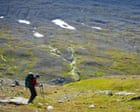
The Präststigen or Priests’ trail in northern Sweden. Photograph: Arctic Sweden View image in fullscreen The Präststigen or Priests’ trail in northern Sweden. Photograph: Arctic Sweden Sweden holidays Europe’s wildest pilgrimage route: a trek through the mountains of north-west Sweden A remote 18th-century chapel deep in Sami lands is the goal of the Präststigen, a 37-mile trail that traverses some of the country’s most spectacular scenery
Prefer the Guardian on Google I wasn’t exactly in “Sunday best”, but I had made some effort. Well, I’d changed my underwear for the first time in a couple of days and given myself a baby-wipe bath. Still, as we filed into the chapel at Alkavare, I felt more a member of an expedition than a congregation. We sat on the low wooden benches, waterproof jackets rustling and leather walking boots stamping on the flagstone floor to keep warm. Fortunately, the priest, Mogens Amstrup Jacobsen, appeared to be a “man of the Gore-Tex”, as well as a man of the cloth, as he unzipped his own black rain jacket to reveal his dog collar. As the service began, the Arctic wind whipped through cracks in the dry stone walls, insulated only with reindeer hair, and candles flickered in their brass sconces.
Read more I had hiked to Alkavare following the Präststigen , or “Priests’ trail”, a 37-mile (60km) route from Kvikkjokk that could stake a claim as Europe’s wildest pilgrimage route, and certainly one of its most beautiful. The Präststigen follows the path that priests would once have taken to the chapel, built in 1788, to perform a service each summer, and today, on the last weekend in July, intrepid hikers and perseverant pilgrims can attend that same service.
Alkavare sits on the western border of Sweden’s Sarek national park, home to many of the country’s highest mountains and steepest valleys, yet with no campsites or tourist huts and only scant sections of the more famous Kungsleden trail. There are no other marked paths and to hike here means wild camping, a heavy backpack and a sense of adventure. It was described by famed Swedish diplomat Dag Hammarskjöld in 1926 as vår sista stora vildmark – “ our last great wilderness”.
View image in fullscreen Wild camping en route. Photograph: Arctic Sweden “I hate it when people use the term ‘wilderness’,” Christian Heimrot from Laponia Adventures, a local guiding operator, told me, as I joined him on the research exhibition for a new Präststigen group trip launching next year. “This is a living landscape, people have lived, worked and shaped this land for thousands of years.” Indeed, Sarek national park , (as part of the wider Laponia region), was recognised as a Unsesco World Heritage Site in 1996 for both its cultural and natural value.
There are no other marked paths, and to hike here means wild camping, a heavy backpack and a sense of adventure The Sami, Europe’s last Indigenous population, have braided themselves into these landscapes as tightly and beautifully as the thread of pewter in their traditional handicrafts. The Sami word for the Laponia area is Sápmi , the same word they use to refer to themselves, highlighting the indelible link between people and their environment. Sarek sits on the Sami’s traditional reindeer herding grounds. While they might now use motorcycles and snowmobiles to follow and herd the reindeer, their knowledge of and kinship with this landscape remains undimmed.
So, not wilderness, then, but certainly wild. To even reach the start of…