
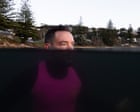
‘I assumed I already knew what fear felt like – I had surfed in rough conditions before, saved lives in the ocean and pursued plenty of adventure in my early years – but this was different’: Graham Russell. Photograph: Blake Sharp-Wiggins/The Guardian View image in fullscreen ‘I assumed I already knew what fear felt like – I had surfed in rough conditions before, saved lives in the ocean and pursued plenty of adventure in my early years – but this was different’: Graham Russell. Photograph: Blake Sharp-Wiggins/The Guardian Stroke I survived a stroke during an ocean swim. Here’s what I’ve learned about fear After his stroke in rough surf, Graham Russell embarked on an unexpected journey into fear. Three lessons helped him return to the joy of the ocean
Graham Russell Sat 12 Sep 2026 22.00 CEST Last modified on Sun 13 Sep 2026 04.57 CEST Share Prefer the Guardian on Google L ooking out over the ocean, I would watch the waves sparkling in the sunlight as they grew and spilled into a burst of froth. It was a fun way to relax, to breathe deep and enjoy an awesome display of energy. But lately it had become exhausting.
In winter last year I tore the lining of an artery in my neck during a rough ocean swim off the Central Coast of New South Wales. It caused a stroke while I was in the water, which saw me scrambling back to shore where a surfer noticed me and sounded the alarm. Six months later, the injury had healed, and my motor functions were all back to normal. But as I prepared for a dip in calm conditions on a sunny day in January, I paused. An unexpected journey into fear began.
Standing on the sand, a thousand scenarios would play out in my mind: how big was that wave? Was it powerful enough to injure me? Where would the currents take me? Would I be safe?
View image in fullscreen Distant storms create waves, which coalesce to form swells whose power emerges much later. Fear seemed to behave similarly. Photograph: Blake Sharp-Wiggins/The Guardian I assumed I already knew what fear felt like – I had surfed in rough conditions before, saved lives in the ocean and pursued plenty of adventure in my early years – but this was different. This was fear in the total absence of any bravado or exhilaration or reward. It did not feel like a physical challenge to surmount, it felt simply like my energy would disappear and I would sink beneath the waves.
I would stand on the shore for an age, scrunching up my eyes against the morning sun and scrutinising the conditions for so long that my face would start to ache.
It started as a straightforward fear of being fearful. In the days after I left the emergency department, my thoughts revolved around: what if I saw the beach where it happened and freaked? Would I take fright the moment the chill water hit my skin? What if the sound of a crashing wave sent me back to that day? I was scared to even turn my neck to breathe when swimming freestyle. Thankfully, it turned out I loved the ocean just as before. The real fear came later. It came embedded inside fatigue.
Sign up for a weekly email featuring our best reads
The neurologist advised me it could take six months for post-stroke fatigue to ease. That felt like a long time. I was impatient to be out there, doing everything I did before, maybe doing it better. Pushing, pushing, pushing. I cannot express how keen I was to get back to work, to pull my bootcamp boxing gloves on again, to get stronger. But each time I tried, I was getting weaker. The sc…