
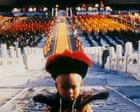
The Last Emperor was produced by Jeremy Thomas and directed by Bernardo Bertolucci. It was based on the autobiography of Puyi, who was made emperor of China in 1908 at the age of three. Photograph: Hemdale/Allstar View image in fullscreen The Last Emperor was produced by Jeremy Thomas and directed by Bernardo Bertolucci. It was based on the autobiography of Puyi, who was made emperor of China in 1908 at the age of three. Photograph: Hemdale/Allstar Film Obituary Jeremy Thomas obituary Film producer who enjoyed his greatest success with the 1987 epic The Last Emperor for which he won an Oscar
Prefer the Guardian on Google Asked whether he had ever cautioned restraint from a director, the film producer Jeremy Thomas replied: “My nature would be to go further and see what we can get away with.”
Thomas, who has died aged 77, was an expert in getting away with it. A taste for irreverence ran in his family: he was the son of Ralph Thomas , director of the Doctor … comedies that began in 1954 with Doctor in the House, and the nephew of Gerald Thomas, who made all 31 Carry On titles. Jeremy’s own films, however, were risky rather than risque.
Bad Timing (1980), the first of three collaborations with the director Nicolas Roeg , explored a destructive love affair blighted by jealousy, attempted suicide and rape. Rank, the studio behind it, withheld from the start of the print its familiar company ident showing a man striking a gong. According to Thomas, the studio also denounced the picture as “a sick film made by sick people for sick people”.
View image in fullscreen Jeremy Thomas ‘was almost like a genre himself: the last of the great cigar-smoking producers’. Photograph: Anoush Abrar He teamed up on several occasions with David Cronenberg , first for an adaptation of William S Burroughs’s Naked Lunch (1991), featuring a sentient, fleshy typewriter that talks through its anus, and most infamously for a film of Crash (1996), JG Ballard’s novel about a group of outsiders who get their sexual kicks from car accidents.
The furore began at the film’s premiere in Cannes, where it was awarded a prize against the wishes of that year’s jury president, Francis Ford Coppola , and then spilled on to UK tabloid front pages. The Evening Standard said Crash went “beyond the bounds of depravity”; the Daily Mail’s sustained calls for it to be banned were heeded by Westminster council, which blocked screenings in the borough. However, the RAC suggested the film might have a useful educational dimension.
Controversy was a by-product of Thomas’s work rather than a goal. His greatest success was The Last Emperor (1987), based on the autobiography of Puyi, from the Qing dynasty, who was made emperor of China in 1908 at the age of three before being exiled 16 years later.
This sumptuous epic, which took four years to make and went on to convert all nine of its Oscar nominations into prizes, was fraught with its own risks and obstacles. “If I’d thought about what we were going to do and how we were going to do it, I’d never have done it because it was impossible,” Thomas said.
He raised the $25m budget and pulled off the coup of making this the first – and, to date, only – western production allowed to shoot inside China’s Forbidden City.
The director Bernardo Bertolucci believed in him from their first meeting. “The films [Thomas] had produced all required courage and ambition. He was the indie producer we all dreamed of.” He saw in Thomas the “enthusiasm of…