
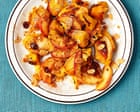
Felicity Cloake’s perfect apfelschmarrn. Photograph: Dan Jones/The Guardian. Food styling: Stevie Taylor. View image in fullscreen Felicity Cloake’s perfect apfelschmarrn. Photograph: Dan Jones/The Guardian. Food styling: Stevie Taylor. How to cook the perfect ... Food How to make the perfect apfelschmarrn – recipe This fruity central European pancake dish can be served as part of a main course or as a dessert. Our resident perfektionistin flips through a selection of the best recipes
Felicity Cloake Sun 20 Sep 2026 14.00 CEST Last modified on Sun 20 Sep 2026 14.02 CEST Share Prefer the Guardian on Google Schmarr n , or schmarren , Anja Dunk writes, is “peasant food at its best: filling, simple and comforting”. The usual English translation, pancake , a dish we generally associate with delicate desserts is, I think, somewhat misleading; schmarren, as it’s also spelled, bears very little resemblance to a thin, lacy crepe, and instead sits somewhere between our own plump, rich Shrove Tuesday numbers and a batter pudding . Indeed, you’ll find it on the sweets section of restaurant and cafe menus, but in Germany, Dunk reports in her book Strudel, Noodles and Dumplings , it “passes as a main meal, not dessert, because it is very filling and not particularly sweet in flavour”, and also, I suspect, because “it takes 10 minutes to make from start to finish” and is therefore a brilliantly quick supper. (“Quite frankly,” she adds,” as a mother, I find this recipe a godsend.”)
Austro-Hungarian in origin, it’s eaten in both Germany and Austria, and there are many variations, including kaiserschmarren (studded with rum-soaked raisins), savoury potato schmarren, semolina schmarren and bread schmarren, though fruit, often apples, but also stone fruit or berries, seems to be the most common pairing. Whether you’re serving this as a main course (it goes very well with sausages) or afterwards, it’s a very handy addition to the repertoire, especially when paired with soured cream or ice-cream.
View image in fullscreen Alfons Schuhbeck’s apfelschmarrn uses twice as much flour as other recipes. All thumbnail images by Felicity Cloake. The batter All the batters I try are made with the same basic ingredients: eggs, flour and milk. Where this differs from a standard pancake, or indeed a batter pudding, though, is that the whites are whisked and then folded into the batter, to give a kind of souffle effect that prevents this undeniably hearty dish tipping over into full-scale heaviness. That said, the ratios of each ingredient are of course important. Alfons Schuhbeck’s recipe in The German Cookbook includes more than twice as much flour as almost every other recipe I try, and more milk, too, yielding a flat, dense result that, while tasty, lacks the lightness of the others. Ernest R Schulz of Larchmont, NY, who sent his recipe to the New York Times in 1980 in outraged response to food editor Craig Claiborne’s description of a kaiserschmarren as a rolled crepe, is the only one to use a similar quantity of milk to flour, which makes for a very liquid batter that’s deliciously smooth to eat, but difficult to turn in the pan.
My testers express a marked preference for the more egg-heavy recipes from Dunk and the Discover SüdTirol website , which prove lighter and fluffier, and have a richer flavour; the latter uses an equal proportion of milk and cream, which is even nicer, though if you don’t have cream in the house, just add more milk. There’s also the ques…