
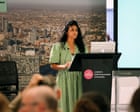
‘Being in an environment that’s built for you is so important’ … Amanprit Arnold speaks at an urban planning event View image in fullscreen ‘Being in an environment that’s built for you is so important’ … Amanprit Arnold speaks at an urban planning event Architecture ‘Our culture is rich and we need our own space’: the fight to build a permanent centre for Deaf people In the UK, 18 million people are hard of hearing – yet there is no dedicated centre for the Deaf community. Now urban planner and activist Amanprit Arnold has made it her mission
Alice Fisher Mon 21 Sep 2026 09.00 CEST Share Prefer the Guardian on Google M eeting outdoors became second nature for most of us over this long, hot summer, but Amanprit Arnold doesn’t get the luxury of choice. She’s sitting at a terrace table when we meet at a cafe because she’s a member of the Deaf community (Deaf with a capital D denotes membership of a unique cultural and linguistic minority).
“Nowhere in London is specifically designed for me,” says Arnold, who was born deaf and used hearing aids before getting cochlear implants at 21. “Inside a cafe, the acoustics can be so bad. It’s much easier for me to hear out here.”
Despite there being 18 million people with hearing issues in the UK , deaf people can often be made to feel like outsiders (even when they’re not sitting outside). Mainstream representation has grown thanks to actor Rose Ayling-Ellis lifting the glitterball trophy on Strictly Come Dancing in 2021 and Fury on the Gladiators reboot. Critically acclaimed films such as Sound of Metal and Coda – which won the best picture Oscar in 2022 – showcased the talents of deaf actors and writers, and the mesmerising skills of sign language interpreters at rap performances regularly go viral. But this has not led to a dedicated centre for the Deaf arts anywhere in the UK.
View image in fullscreen Sign of the times … an image by the Deaf Architecture Front. Photograph: Deaf Architecture Front Arnold wants to change that. She has started the DeafCity Hub campaign to create or adapt a building using deaf-friendly architectural guidelines called DeafSpace principles to provide, at last, a co-working and cultural space for her community.
We have a really strong cultural identity element and we need somewhere to celebrate that While there are cafes and clubs that bring deaf people together socially around the UK, Arnold sees the DeafCity Hub as a national centre as well as a meeting place. This month, the project has landed a year-long “meanwhile” space (a building awaiting redevelopment) through a partnership with Westminster city council and the Oxford Street Development Corporation, which gives her the chance to prove a place like this is needed.
“There is greater visibility of deaf people in the media,” says Arnold, “but when it comes to property and place-making for them, there’s nothing. We have a really strong cultural identity element and we need somewhere to celebrate that, somewhere made for us.”
Arnold’s career is in urban planning and strategy, but there’s activism in her background, too. (“In my family, that’s what we do,” she says with a smile.) Her father was race relations director for Birmingham city council in the 1990s and her grandfather was a trade unionist and antiracism campaigner . Arnold’s design agency, Disability Urbanism , specialises in accessibility, helping city planners and real estate developers create welcoming environments for people with disabilities.…