
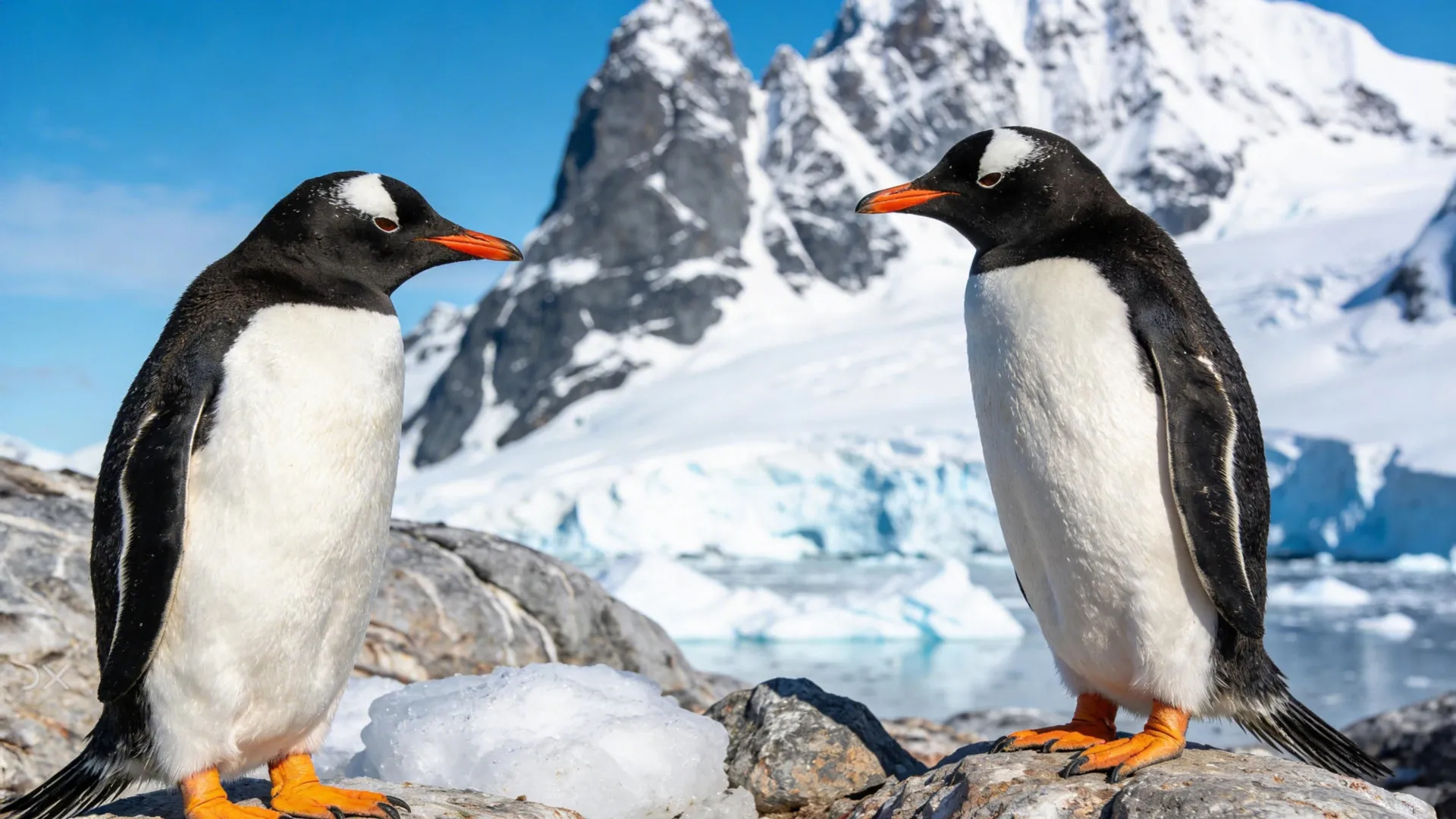
Antarctica's four-foot-tall Emperor penguin may be the best-known member of the penguin family, but it is far from alone. Seventeen other penguin species live across the Southern Hemisphere, and many inhabit isolated islands that are difficult for scientists to reach and study.
That remoteness may help explain how an entire species of gentoo penguin escaped recognition for so long. The birds live on the Kerguelen Islands, known in French as the Desolation Islands, nearly 2,000 miles from any permanently inhabited landmass. An international team led by researchers in Chile and at the University of California, Berkeley has now identified the population as a distinct species, making it the first new penguin species named in more than 100 years. The findings were published in Communications Biology .
Genetic evidence shows that what scientists once treated as a single, widely distributed gentoo penguin species is actually made up of four separate species.
One of them had never been formally recognized. Apart from subtle differences in body size and vocalizations, it closely resembles other gentoos, with the familiar white underside and black back that help penguins avoid predators and hunt prey in the ocean. Genetically, however, it is clearly distinct. Scientists call this type of organism a cryptic species, meaning it looks very similar to related species despite having significant genetic differences.
The researchers also determined that three gentoo populations previously classified as subspecies are different enough genetically to be recognized as full species.
The newly recognized southeastern gentoo penguin, Pygoscelis kerguelensis , may face an uncertain future. Two of the other newly defined species could also be vulnerable as global warming reshapes the Antarctic and sub-Antarctic regions where they live. The southern gentoo, now known as Pygoscelis ellsworthi , is the only one of the four that lives in Antarctica. Climate projections suggest it may be affected relatively little and could even expand its range.
"In Antarctica, of course, other species, not the gentoo, are threatened by climate change," said Juliana Vianna, one of the paper's senior authors and a professor of ecosystems and environment at Andrés Bello National University in Santiago, Chile. "But the gentoo is of most concern in the sub-Antarctic region," an area of widely separated islands north of Antarctica governed by numerous countries, including Chile, South Africa, France, the Netherlands, Australia and New Zealand,
"It's very important that conservation institutions in all the different countries involved recognize and take appropriate action to save these three gentoo penguin species," she added.
A Century of Debate Over Gentoo Penguins
To settle long-running disagreements over gentoo classification, Vianna joined forces with co-senior authors Rauri Bowie, a professor of integrative biology at UC Berkeley, and Elie Poulin, a professor at the University of Chile in Santiago. Together they brought penguin specialists from around the world into a broad genomic study of gentoo populations.
Previous researchers had proposed as many as six gentoo subspecies, but there was no universal agreement. The new work represents a consensus built from whole-genome sequences of 64 penguins collected from 10 breeding colonies. For the first time, the sampling covered nearly the entire geographic range of gentoo penguins.
The team also compared physical and…