
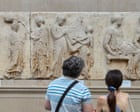
Some of the Parthenon sculptures on view at the British Museum in London. Photograph: David Levene/The Guardian View image in fullscreen Some of the Parthenon sculptures on view at the British Museum in London. Photograph: David Levene/The Guardian Opinion Parthenon marbles Britain would not cut up the Bayeux tapestry. So seize this moment and reunite the Parthenon sculptures in Greece Kyriakos Mitsotakis Both Greek and British citizens think the sculptures should be returned. What’s needed now is political will and courage
Kyriakos Mitsotakis is the prime minister of Greece
F or the first time in nearly 1,000 years, the Bayeux tapestry is back in Britain . Its arrival is a significant cultural moment, and a reminder that, in an age of social media and ubiquitous screens, historic objects still capture the public imagination.
The British Museum describes the tapestry as one of the “wonders of the medieval world”. But the museum already houses many wonders, including one that is instantly recognisable: the Parthenon sculptures, chiselled away and illegally removed from Athens to be taken to Britain more than two centuries ago by Lord Elgin.
There are striking similarities between the two pieces. Both were conceived as single works, intended to be seen and understood as a whole. In the case of the Parthenon sculptures, that relationship is also architectural: they were created as inseparable elements of the monument itself. Nobody would seriously contemplate cutting what survives of the tapestry in two and displaying half in London and half in Bayeux, and claiming this was an adequate way to understand it. Yet that is exactly what happened to the Parthenon sculptures. A single masterpiece was divided, and its surviving parts are now principally split between London and Athens.
The sculptures tell a story of unique historical importance. Not only of gods and heroes, but also of ordinary civil life in ancient Athens. They gave a visual expression in stone to the religious, civic and political identity of fifth-century Athens. The Parthenon frieze, in particular, remains one of the world’s most compelling representations of the collective life of the city from which democracy emerged. It is a powerful celebration of Athenian democracy.
Unlike the sculptures, the Bayeux tapestry survives as one continuous work, measuring nearly 70 metres. It too tells a story, from the events preceding the Norman Conquest to the battle of Hastings and the death of Harold. Its wonder lies not just in the individual scenes, but in the way they are experienced together as a whole.
View image in fullscreen The Parthenon gallery at the Acropolis Museum in Athens. Photograph: Louisa Gouliamaki/Reuters The case for reunification is not an argument for emptying the world’s museums. The Parthenon constitutes a specific and exceptional case. The issue is not merely one of possession or legal title. It concerns the restoration of the physical, aesthetic and conceptual integrity of a dismembered monument of outstanding universal value.
The surviving sculptures should be viewed together, at the same time, within sight of the monument for which they were created. The Acropolis Museum was designed specifically to make this possible.
Greece cannot accept any arrangement that would require it to recognise the British Museum’s ownership of the sculptures , or a scheme that would mean we “borrow” parts of our own monument. And the British public is increasingly on Gree…