
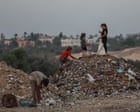
Children in Gaza sift through rubbish for plastic and wood to support their families. ‘The more war there is, the more the Nobel peace prize matters.’ Photograph: Anadolu/Getty Images View image in fullscreen Children in Gaza sift through rubbish for plastic and wood to support their families. ‘The more war there is, the more the Nobel peace prize matters.’ Photograph: Anadolu/Getty Images Opinion Nobel peace prize Donald Trump? Please no. Here’s who actually deserves this year’s Nobel peace prize Haakon Gjerløw The betting markets favour the US president and Volodymyr Zelenskyy. But the most vital work to secure peace is being done by those far from the spotlight
Haakon Gjerløw is the acting director of the Peace Research Institute Oslo
T he Nobel peace prize is not a contest determined by fame. Yet the betting markets consistently gravitate towards the biggest names in global politics – among them this year, Donald Trump and Volodymyr Zelenskyy.
That misses what the prize is for. The real work of building peace is often done far from the headlines: by courts that uphold international law, journalists who document atrocities, and humanitarian organisations that protect communities. With the 2026 prize due to be announced on 9 October, the Nobel committee has an opportunity to remind the world that peace is built through institutions and cooperation, not just diplomatic grandstanding.
Despite the favourable odds, Trump will not win. A sitting president waging a war against Iran is an impossible candidate for a prize intended to advance peace. Whatever Trump’s diplomatic efforts elsewhere, the Nobel committee will consider the totality of a candidate’s contribution – a record that now includes allegations of US war crimes .
The Ukrainian president is also unlikely to win. Awarding the Nobel peace prize to the serving commander-in-chief of a country fighting a major war would risk turning the prize into an endorsement of one side in the conflict, regardless of Ukraine’s right to defend itself. It would also sit uneasily with Alfred Nobel’s will , which called for efforts to promote “fraternity between nations”, reduce standing armies and advance peace.
View image in fullscreen Volodymyr Zelenskyy listening to a briefing at a command centre bunker in Zaporizhzhia, Ukraine, in November 2025. Photograph: Ukraine Presidency/Ukrainian Pre/Planet Pix/ZUMA Press Wire/Shutterstock Look past the headline-grabbing names, and Save the Children, Sudan’s Emergency Response Rooms and the international court of justice all feature near the top of Polymarket’s rankings , with a current combined 28% chance of winning. On these candidates, the markets may well be closer to calling the result. But they are also missing several of the world’s most deserving peace-builders.
As head of the Peace Research Institute Oslo , an independent body that conducts research on the conditions for peaceful relations between nations, groups and individuals, I am regularly asked whether the prize should be awarded at all, given the scale of conflict today. The wars in Ukraine and Sudan continue to exact a massive human toll, while the war involving Iran has added another dangerous front to an unstable international landscape. Our latest conflict trends report recorded 65 state-based armed conflicts in 2025 – the highest number since records began in 1946.
Such a backdrop only strengthens my belief that the more war there is, the more the Nobel peace prize matters.
T…