
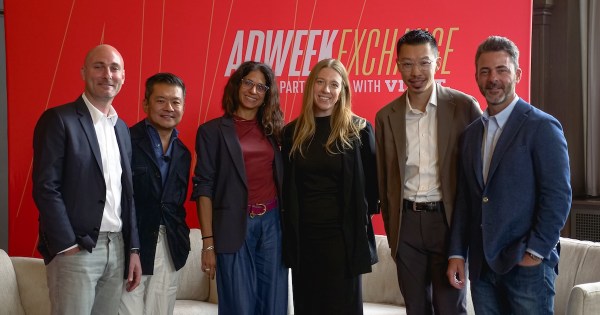
(L-R) Viant's Tim Vanderhook, ADWEEK's Will Lee, Nutrafol's Deena Bahri, Rocket's Sarah Tarraf, TVision's Yan Liu, Viant's Chris Vanderhook Corey Presley By Ashley R. Cummings --> ADWEEK House: Advertising HQ brings the people shaping advertising, commerce, and media together for four days of unscripted conversations and after-hours connections. Meet us in Midtown, Oct. 5–8.
This post was created in partnership with Viant
As TV and streaming audiences become increasingly fragmented, understanding what happens between an ad being served and a viewer paying attention is becoming a more important part of evaluating media.
That question was at the heart of ADWEEK Exchange in Detroit, the first stop on a national roadshow from Viant and ADWEEK spanning the country’s leading advertising markets. The event brought marketers together to explore what attention data can reveal about whether an ad was actually watched.
Yan Liu, CEO of TVision, opened the event by discussing the gap between TV exposure and attention. The average U.S. consumer spends 213.5 minutes a day—nearly four hours—with television and streaming video, he shared. Of that time, approximately 24.5 minutes are spent with advertising, and only nine minutes represent actual attention to those ads.
Liu pointed out that viewers are often in the room without watching, and sometimes an ad plays to an empty room. In these instances, a completed view measures playback, but not attention.
Liu then linked attention to outcomes. In one study, TVision looked at hundreds of campaigns across 20 different industries, and found each percentage-point increase in attention corresponded to nearly a 1% increase in ad awareness.
Liu also stressed that context affected attention. Using another example, Liu showed that the same ad drew more attention alongside sci-fi and sports content than news and reality shows.
“It’s the same creative. It’s just different context,” Liu explained. For marketers, that means where an ad appears can affect how much attention it earns, even when the creative stays the same.
He closed with attention data from the recent Thursday night football game between the Detroit Lions and Buffalo Bills. Attention fell as the score widened, then rose when the game became more competitive in the third quarter. The second half drew more attention than the first, which Liu described as unusual for a football game. He also noted that fewer people were watching together after halftime.
The example illustrated how both the content on screen and the viewing environment can affect attention—raising a question for marketers: If attention can vary based on context, creative, and even what is happening in the moment, how should brands put that information to work?
That question carried into the panel that followed, as Will Lee, CEO of ADWEEK, brought together marketing leaders Deena Bahri, CMO at Nutrafol; Sarah Tarraf, SVP of knowledge and insights at Rocket; and Chris Vanderhook, chief operating officer and co-founder of Viant.
Lee opened with a question raised by Liu’s presentation: Does attention translate into action?
Bahri said she had come in skeptical that attention would correlate with action, but Liu’s presentation left her intrigued by the possibility. Tarraf was also intrigued, wondering whether an ad interrupting a program caused viewers to check out or whether their attention carried over to the ad.
For Vanderhook, the question is part of a broader effort…