
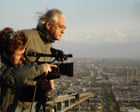
Patricio Guzmán directing Nostalgia for the Light (2001). Photograph: Atacama Productions/Blinker Film/WDR/TVe/Kobal/Shutterstock View image in fullscreen Patricio Guzmán directing Nostalgia for the Light (2001). Photograph: Atacama Productions/Blinker Film/WDR/TVe/Kobal/Shutterstock Film Obituary Patricio Guzmán obituary Chilean film-maker whose trilogy on Augusto Pinochet’s coup brought him to international attention
Prefer the Guardian on Google Hawker Hunter jets bomb the presidential palace in the Chilean capital, Santiago, setting it ablaze. It is 11 September 1973, and General Augusto Pinochet ’s bloody coup against Salvador Allende’s socialist government is under way.
These are the dramatic opening images of the documentary film trilogy La Batalla de Chile (The Battle of Chile), directed by Patricio Guzmán. The three films detail the struggles of the Allende government to stay in power and promote what it termed “the peaceful road to socialism”. Filmed at the time with interviews, direct footage of demonstrations, debates about how to take the Allende government forward and opposition attacks that eventually led to Pinochet’s brutal seizure of power, it had a hard-hitting immediacy that brought Guzmán a huge audience and reputation outside Chile – although the three films remained banned for many years in his own country.
While he was filming during the September 1973 coup, Guzmán, who has died aged 85, was arrested and became one of the thousands of people taken to the Estadio Nacional football stadium in Santiago, where many were arbitrarily imprisoned and tortured. He was released after a fortnight and left the country in November, first going to Spain and then Cuba, before settling in Paris, where he lived for most of the rest of his life.
View image in fullscreen Salvador Allende in The Battle of Chile. Photograph: Collection Christophel/Equipe Tercer Ano/Instituto Cubano/Alamy The many reels of film shot by Guzmán and his team during the years of the Allende government and then at the point of the Pinochet coup were rescued from Chile by Harald Edelstam, the Swedish ambassador, who sent them in a diplomatic bag to Europe. They ended up at the film institute in Cuba, where they were edited by Guzmán over the following years to become La Insurreción de la Burguesía (The Insurrection of the Bourgeoisie, 1975), El Golpe de Estado (The Coup, 1976) and El Poder Popular (Popular Power, 1979).
Patricio was born in Santiago, the only child of an architect, Luis Guzmán, and his wife, María Lozanes, who was born in Chile of Bolivian parents. His first job was in a local advertising agency, which he left to study film at the Universidad Católica, before spending a year at the Escuela Oficial de Cinematografía in Madrid, graduating with a diploma in film direction in 1970.
After his return to Chile in 1971, he directed his first feature-length documentary, El Primer Año (The First Year), which dealt with the initial 12 months of Allende’s government and set him on the path to chronicling the momentous political events happening around him. As a film-maker he was acutely aware that if he did not record these events, the memory of them could be lost for ever.
View image in fullscreen The Cordillera of Dreams, 2019. Photograph: Atacama Productions/Album/Alamy After being exiled, Guzmán returned briefly to Chile in 1987, while Pinochet was still in power, to make a film for Spanish television, En Nombre de Dios (In the Name of God),…