
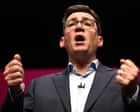
Party conference speeches by a leader are rather weird and antiquated constructions. There is almost no other time in the year when a PM, or an opposition leader, gives a speech uninterrupted for an hour or so. Some are great, some are mediocre, but normally even the better speakers tend to lose the audience halfway through as they rattle through second-order issues included to keep an interest group happy.
Andy Burnham’s speech today was a rare exception. Because it was emotionally engaging, because it was laced with anger and it felt like a speech 15 years in the making, because it had a coherent argument, because it was quite colloquial, and perhaps because Burnham was not standing at a lectern, this was much more interesting and watchable than these speeches usually are. Normally, 40 minutes in, you are desperate for it to end. I would have happily listened to Burnham for another half an hour.
On substance, it was strong – but perhaps not quite as bold as Burnham maintains. His ambitions on social care are in the best traditions of “Go Big” (see 8.40am ) and Burnham has shown himself to be a politician confident of his ability to turn public opinion on a big, difficult issue (getting rid of the triple lock). It was bold and inspiring. But whether it turns out to be effective remains to be seen, and if Burnham fails to win this argument, he has got time to trim, or back down.
On PR and Europe, he also staked out brave positions that will attract considerable opposition – not just out in the country, but from some in Labour too. But here he was a bit less specific than on social care and pensions. He implied PR would be in the Labour manifesto, but he just said he would fight the election on a proposal “ to change the electoral system so that everyone’s vote counts”, which implied something less ambitious than PR – the alternative vote, perhaps, or PR for an elected Lords? – might end up to be the only option he thinks he can sell to the PLP.
And, on Europe, Burnham implied that he will open a conversation on rejoining. But he was not explicit about that, and then he started talking about “consensus” – which sounded naive because there no subject in British life on which consensus seems less possible than Brexit. One colleague has a theory that Burnham wrote the speech planning to end with a flourish saying rejoining would be an option (like Keir Starmer saying “nobody is ruling out remain” in his 2018 speech ) – only to drop the wording at the last minute. There was definitely a bit of a hiatus at the end where the speech had been building up to a big reveal. (See 3.10pm .)
Still, this speech was daring, moving and – potentially – transformational. Burnham has had a good week, and today it got better.