
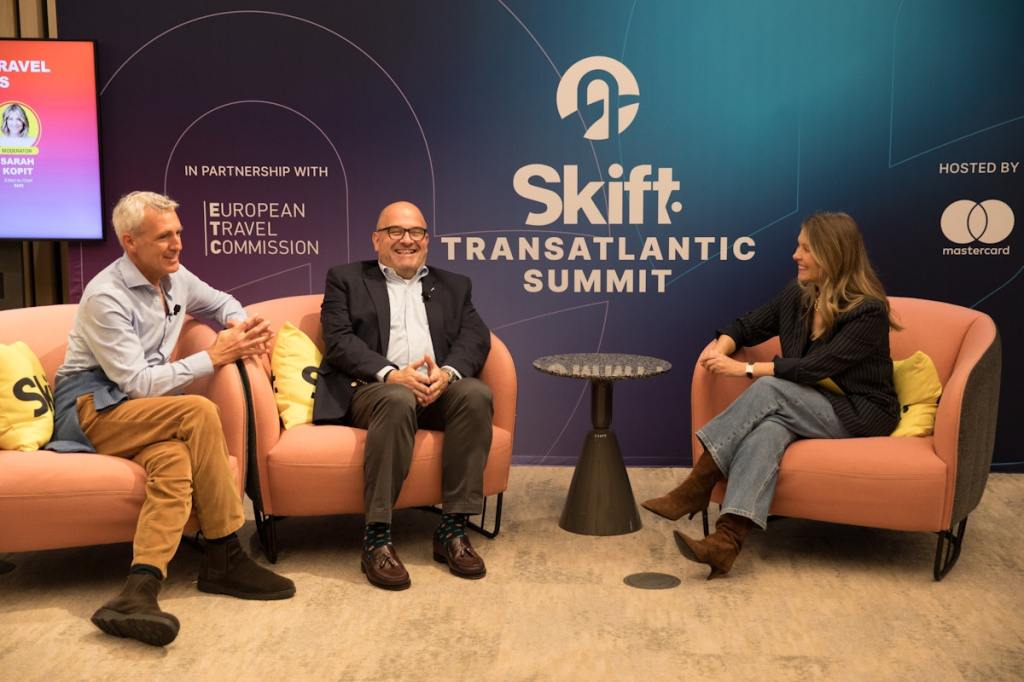
The transatlantic corridor remains one of travel’s most important markets — and also one of the most exposed to global disruption.
Geopolitics, rising costs, changing traveler behavior, and new technology are forcing companies to rethink where new growth will come from.
Europe’s international arrivals were up 5.0% year-to-date in 2026, but performance varies sharply by market and region. [1] The Skift Transatlantic Summit will focus on five decisions leaders are making now across demand, politics, destination strategy, AI, and mobility.
For senior leaders, director level and above. Applications are reviewed; places are limited and not guaranteed.
Cross-border demand has held up, but performance is uneven across markets and regions. Costs, confidence, connectivity, and perceptions of safety are shifting demand between destinations and seasons.
The decision is whether to stay the course in markets that are still performing or rebalance investment around a more volatile demand environment.
Overnight stays in Europe are up 4.8% year-to-date. Northern Europe led all subregions, with arrivals up 10.0% and nights up 8.4%. [ 1 ]
Politics is no longer background noise for travel. Conflict can change connectivity and costs overnight, while policy shifts can affect access, sentiment, and market economics. Companies still have to price, market, and commit capacity before the political picture becomes clear.
The practical decision is when political risk becomes significant enough to change the commercial plan.
Geopolitical disruption is already changing travel patterns: ETC found travelers increasingly prioritizing destinations they perceive as safe and good value, traveling closer to home, and spreading trips more evenly across the year. [ 1 ]
Marketing alone won’t redistribute demand. Secondary destinations need connectivity, capacity, and enough demand to support service without recreating the pressures of major gateways.
The test is whether dispersal changes where and when people actually travel, or whether it remains a promise inside a marketing campaign.
Roughly 80% of European travel demand is intra-regional, giving destinations a large existing pool of travelers to redirect across places and seasons. It also underscores the huge potential of growing the transatlantic corridor. [ 4 ]
AI is becoming part of travel discovery faster than it is becoming a transaction channel. Seventy-one percent of travelers are comfortable using AI for inspiration, but only about half are comfortable letting it make a flight or hotel booking. [3]
That creates a new tension for destinations and suppliers: they need to be visible inside AI systems without giving up the trust and customer relationship that still drive direct bookings. Forty-nine percent of travelers cite greater trust in a supplier’s website as their top reason for booking direct. [3]
AI accounts for 21% of touchpoints during inspiration, but just 6% at booking. Travelers are comfortable using AI to generate ideas and compare options, but trust falters when money is involved. [ 2 ]
Europe has talked about seamless multimodal travel for years, but travelers still do much of the stitching between air, rail, ferries, and local transport themselves.
Better ground connectivity can extend the reach of international flights into secondary destinations. The near-term question is what airlines, rail operators, destinations, and technology platforms can connect…