
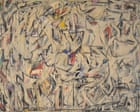
‘Knockout masterpiece’ … Excavation by Willem de Kooning, 1950. Photograph: © 2026 The Willem de Kooning Foundation/ Pictoright, Amsterdam View image in fullscreen ‘Knockout masterpiece’ … Excavation by Willem de Kooning, 1950. Photograph: © 2026 The Willem de Kooning Foundation/ Pictoright, Amsterdam Art and design Review Willem de Kooning review – the artist’s lifelong rebellion against himself is thrilling to watch Rijksmuseum, Amsterdam Marking a century since the Dutch artist stowed away to New York, this vast retrospective gloriously showcases the abstract expressionist’s fierce boundary-pushing
Prefer the Guardian on Google W illem de Kooning was the last great artist who really knew how to draw. More precisely, if less provocatively, he was the last truly transformative painter to have been schooled in the academic tradition that produces what is still recognised, by most people, as “good drawing”. Accurate in the sense of a photograph but, like a filter on your cameraphone, also subtly tidying up the world to meet the ideals of classical proportion. “Draw what you see and not what you think,” the young De Kooning was told. Raw personal emotion had no place – a far cry from what this master of abstract expressionism was to become.
The intense labour required to build a connection between eye, brain and hand so quick as to be instinctive is illustrated by the charcoal still life Dish With Jugs. Made when De Kooning was in his mid-teens, and so minutely rendered that you might mistake it for a sepia photograph, the catalogue estimates that it took 600 hours at the Rotterdam academy to complete. The aim of this exercise was not to produce a single picture so much as to ingrain a way of seeing and reconstructing the world to the point that it becomes inescapable.
View image in fullscreen Like a sepia photograph … De Kooning’s Dish With Jugs, c.1919-21. Photograph: © 2026 The Willem de Kooning Foundation, Pictoright, Amsterdam This brilliantly researched exhibition makes a compelling case for the success of that training. Setting a handful of standout paintings among a wider selection of drawings illustrates the artist’s lifelong rebellion against rules so thoroughly internalised that he could push fiercely at their limits without entirely breaking them. The battle is thrilling to watch.
De Kooning’s formative training is apparent in an early drawing of the dancer Juliet Browner and a marvellously deft portrait of the artist’s wife, Elaine. The influence of Ingres – the Pelé of academic drawing – on these works has often been remarked upon, not least by rival New York painters for whom De Kooning’s superior draughtsmanship was a source of suspicion (too prissy, too European). And it seems that the immigrant artist placed himself under pressure to unstitch the aesthetic conventions of the old world and rework them into something more appropriate to the new: irreverent, free, immediate, expressive.
View image in fullscreen ‘A harbinger of women to come’ … Queen of Hearts. Photograph: © 2026 The Willem de Kooning Foundation/ Pictoright, Amsterdam It is important to note that De Kooning’s education was not limited to the academy. A working-class kid, his evening classes had been subsidised by the design firm where he worked in the day; after stowing away to the US at 22, he scraped a living as a sign painter and commercial illustrator. These lessons made their way into his art, and the difficulty of synthesising them might explain t…