
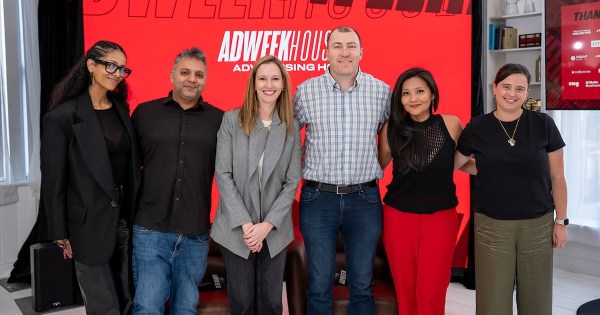
(L-R) Blue Bottle Coffee’s Marisa Smith, Shopify’s Samir Pradhan, Shopify’s Jess Jacobs, Naked & Thriving’s Scott Kramer, Petzey Pet Telehealth’s Ameetess Dira, ADWEEK’s Lauren Johnson By Seth Simons --> This post was created in partnership with Shopify
Marketers must contend with a fragmented customer journey and evolving customer behaviors when calculating customer acquisition costs.
During an ADWEEK House Advertising HQ group chat co-hosted with Shopify, marketing leaders came together to discuss ever-evolving customer behaviors and compare notes on how they price new customers.
It’s a question as old as time: How do you know your marketing spend is getting new customers?
Jess Jacobs, VP of shop growth and marketing at Shopify, answered with the adage: “I know 50% of my marketing is wasted; I just don’t know what 50%.”
Modern marketers may have more measurement techniques to wield, but the problem is that customer behavior keeps evolving. “There’s more confusion and complexity than there ever was,” Jacobs remarked.
Samir Pradhan, VP of product management at Shopify, suggested that successful marketers also keep their eyes on existing customers who haven’t yet become repeat customers.
“The key to me is to understand how much a new customer is worth, how much someone who’s bought from you before becoming more loyal to you is worth, and then adjusting how much you bid or pay for that opportunity,” he said. “Just because they bought from you once doesn’t mean that they truly are your customer.”
Scott Kramer, CMO of Naked & Thriving, uses Shopify’s analytics to identify its CAC across various channels—including Meta, Google, and more recently ChatGPT—and then excludes past customers from future campaigns on those channels.
“That doesn’t mean we shouldn’t spend anything on past customers,” Kramer stressed. “For us, email and SMS are how we want to drive that repeat customer revenue. It’s just very cost efficient.”
Some brands face a different calculation entirely. Ameetess Dira, CMO of Petzey Pet Telehealth, said her focus is less on acquiring new customers—whose need for the service is often out of their control—than on keeping them long term.
“We want to focus on lifetime value: educating the consumers, educating ecosystems that we already support,” Dira explained. “It’s not just for emergencies; it’s not just for triaging.”
As the consumer journey fragments across more channels, marketers have to experiment with different messaging and targeting strategies to drive incremental reach. The more they know their customers—who spends more during the holidays, who tends to stock up on their favorite products—the more impactful their marketing spend will be.
“I’m a very big proponent of understanding consumer behaviors based on your omni touchpoints,” said Marisa Smith, head of growth at Blue Bottle Coffee. “That helps dictate the strategy.”
Pradhan drew a careful distinction between a customer’s lifetime value and their incrementality. A repeat customer isn’t necessarily a sign of effective marketing; it could simply reflect more effective measurement of customers who would have purchased anyway, whether you targeted them or not. “I think holdouts are the main way I would assess whether you’re getting someone who you truly wouldn’t have gotten at a platform level,” he said.
For Kramer, the important metrics to watch are first-click attribution, new visitors versus returning traffic, and…