
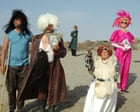
Art and politics … Christoph Schlingensief, The African Twin Towers, 2005. Photograph: © Estate of Christoph Schlingensief View image in fullscreen Art and politics … Christoph Schlingensief, The African Twin Towers, 2005. Photograph: © Estate of Christoph Schlingensief Art Her royal heilness: Berlin show revisits the artist who turned the Queen into a Nazi The late Christoph Schlingensief was one of German art’s great provocateurs. Can his B-Movie horror aesthetics still shock us into thinking anew about media power, colonialism, and the far right?
Hanno Hauenstein Thu 15 Oct 2026 08.00 CEST Last modified on Thu 15 Oct 2026 08.01 CEST Share Prefer the Guardian on Google C hristoph Schlingensief certainly knew how to provoke. “Fury at German play that shows Queen as a Nazi,” read the Sunday Express’s headline after Kaprow City first premiered at Berlin’s Volksbühne theatre in 2006. Drawing on the happenings of US performance artist Allan Kaprow, the play turned its attention to Diana, Princess of Wales’s death. In one scene, the then queen performs a Hitler salute. Another re-enacts the paparazzi chase that led to Diana’s fatal crash. Diana appears in bed beside two men with Down’s syndrome; and Camilla is pelted with animal blood. Schlingensief insisted the work was not meant as provocation but as an investigation into how Diana turned into a modern icon. But his art thrived on outrage, exposing the absurdity of societies that glorify their idols while consuming their lives as entertainment.
Kaprow City is at the heart of a new Berlin show – It’s Not My Problem Anymore, Deal With Your Own Shit – that revisits the artist’s legacy. In the Gropius Bau’s grand neo-Renaissance atrium, visitors encounter remnants of the carousel-like rotating stage he called the “animatograph”. Looking at this installation today feels like a glimpse into Schlingensief’s mind: a messy collage of childhood memories, violent fantasies and royal glamour.
View image in fullscreen Making headlines … It’s Not My Problem Anymore, Deal With Your Own Shit, Gropius Bau. Photograph: © Estate of Christoph Schlingensief The Gropius Bau installed roughly half of Schlingensief’s original set on the very same spot where Joseph Beuys, a major influence, once exhibited his Stag Monuments. In Kaprow City, flickering black-and-white footage of a crucifixion plays beneath a slate board listing the stage’s contents, from “Diana Girl Ballet” to “exorcism”. In the original production, audiences were distributed across 18 tiny, wedge-shaped rooms, echoing Allan Kaprow’s 18 Happenings in 6 Parts. Spectators witnessed only fragments of the action. Now, most of the stage’s interior is draped in plastic. Excerpts of videos from the play loop throughout the installation on old-fashioned TV screens.
Enlarged tabloid headlines and articles are plastered across the walls behind it. Beside the Sunday Express headline, a German newspaper asks: “Will Diana’s sons stop Schlingensief?” After rumours that the royals might pursue legal action, Schlingensief had invited William and Harry to Frieze, where he planned to present an iteration of the project.
“The combination of Lady Di, the speculation surrounding the circumstances of her death, and the general myth that grew around her fascinated Christoph,” says stage designer Aino Laberenz, Schlingensief’s widow who now manages his estate. For the Volksbühne production, Schlingensief cast Jenny Elvers, a German TV personality whose private life,…