
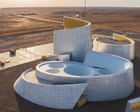
The renowned Beijing-based architecture firm Turenscape came up with the museum’s bold design. Photograph: Turenscape How architects worked with harsh environment to create sustainable building in location where fossils were found
Prefer the Guardian on Google V iewed from afar, the silver-hued Hami Pterosaur Museum almost looks like a space base on Mars. Viewed from above, it resembles a collection of dinosaur eggs in the sand. Nestled in the Gobi desert, in north-west China , the new tourist attraction showcases hundreds of impressive fossils of pterosaurs, ancient flying reptiles related to dinosaurs. But far from reflecting its prehistoric exhibits, the building itself is a modern-day architectural specimen.
Designed with underground exhibition halls, giant light funnels and sprawling solar farms, the museum is able to operate sustainably while withstanding an extremely harsh environment.
View image in fullscreen The Hami Pterosaur Museum is designed so as to require minimal artificial heating and cooling. Photograph: Turenscape The Hami region is notorious for its scorching summers. Air temperatures can exceed 55C (131F), while the surface ground temperature can reach 80C, says Wang Xiaolin, the director of the museum and a palaeontologist at the Chinese Academy of Sciences. Violent winds and sandstorms terrorise the area frequently, according to Xiaolin, who has carried out excavation work in Hami for 20 years.
Despite the intimidating conditions, building the museum in the area is important from a scientific perspective because this is where the fossils were buried and found, Xiaolin says. Keeping the fossils local protects the fragile relics and lets visitors see them in their geological context, he adds.
Visitors to the five exhibition halls can expect to see precious fossils discovered by Xiaolin’s team, including one that has preserved the upper and lower jaws, as well as the soft-tissue structures of the head crest of a pterosaur that roamed the area roughly 130m years ago.
View image in fullscreen Most of the museum’s structure has been built 8-metres deep into the ground of the desert. Photograph: Turenscape Most of the 8,000-sq metre museum is built 8 metres into the ground where temperatures are much lower, which helps it stay cool in summer, says Huai Kaifeng, an architect at Beijing-based Turenscape, which designed the project. In winter, when temperatures can drop below -20C, the design also helps the museum stay warm.
Being largely underground, with seven above-ground entrances, allows the museum to use its energy as efficiently as possible, says Wang Yujia, a landscape architect and associate professor at the University of Nebraska–Lincoln in the US, who is not involved in the project. Most of it is able to avoid direct exposure to wind, sand and solar heat and the large temperature swings between day and night in the desert. “This all means that you need much, much less air-conditioning,” Yujia says.
View image in fullscreen Visitors to the museum will be able to see the fossils in the geological context of where they were found. Photograph: Turenscape Although air-conditioners have been installed to provide backup, the museum has natural ventilation shafts that allow cool air to sink and hot air to rise and escape. The museum can cut its electricity usage on air conditioning by 94% compared with an above-ground counterpart, according to estimates by Turenscape. This equates to a saving of 223,421kWh of ele…