
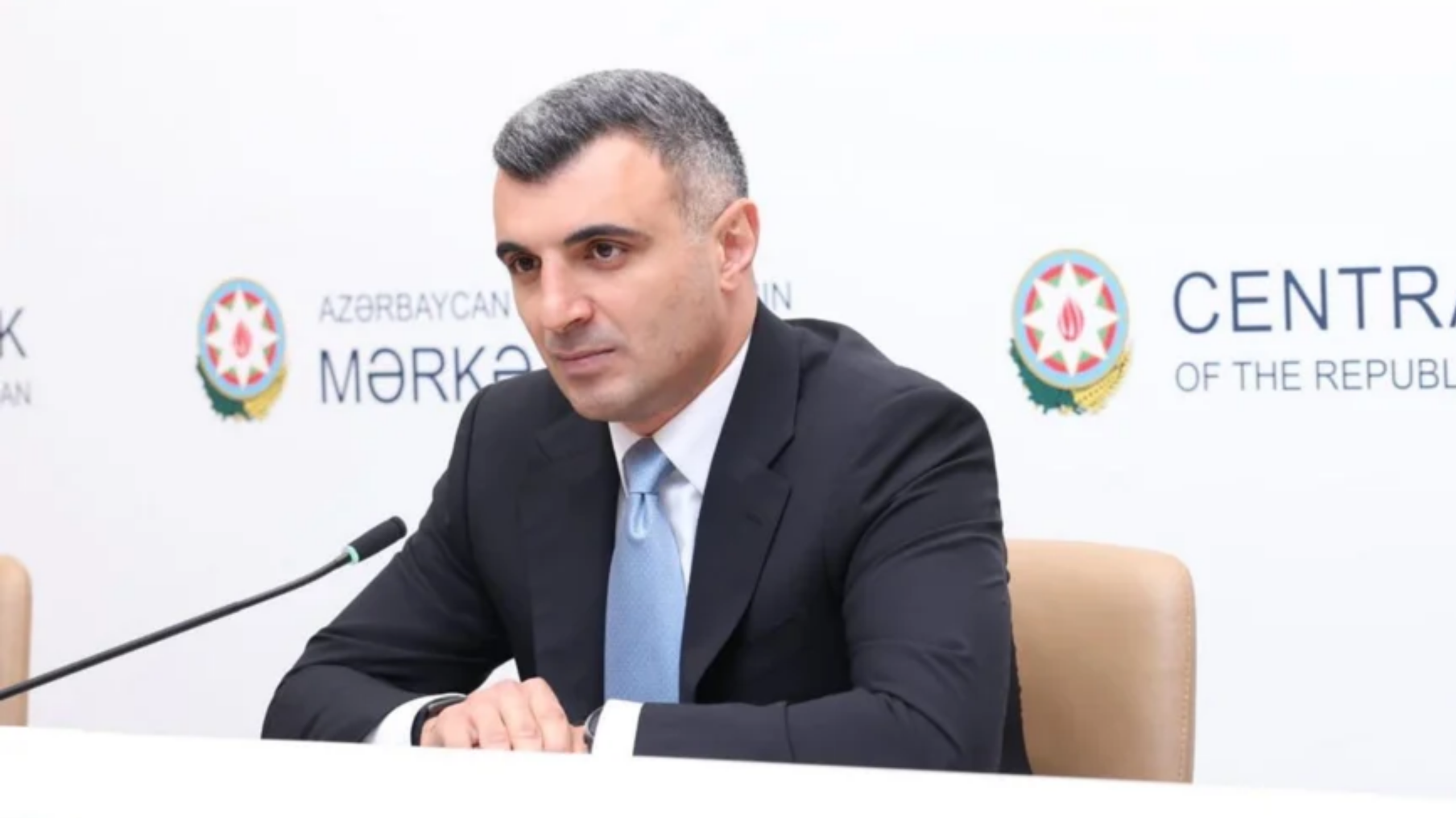
Home Executive Interviews Taleh Kazimov: Shoring Up Resilience
Taleh Kazimov, governor of the Central Bank of the Republic of Azerbaijan, discusses the central bank’s drive to modernize the banking system and how it supports economic diversification.
Global Finance: How well armored is Azerbaijan’s monetary framework against today’s global risks?
Taleh Kazimov: Azerbaijan is an open, small economy; in 2025, trade turnover reached 79.8% of GDP. Energy prices work through three channels that do not point the same way. Directly, a U.S.$10 rise in the oil price adds roughly U.S.$1.2 billion to the current account, and a U.S.$50 rise per thousand cubic meters of gas, about US$900 million.
The second channel runs the opposite way; around 80% of our non-energy imports come from energy-importing economies, so a 10% oil-price increase raises trading-partner inflation by roughly 0.67%. Here, the nominal effective exchange rate absorbs much of the pressure. The third channel runs through the valuation of strategic assets. Netting the three, the overall effect remains clearly positive.
Exchange rate stability is the key nominal anchor; where trade is the dominant transmission channel, a stable nominal rate neutralizes much imported inflation and expectations stay anchored within our corridor of 4%, plus or minus 2 percentage points. Second, an interest rate corridor with standing facilities ensures policy decisions transmit predictably. Third is the buffer stock; strategic reserves rose U.S.$700 million this year to U.S.$85.8 billion at end-June, exceeding 125% of GDP and covering close to 400% of broad money.
GF: What are your priorities for modernizing the framework?
Kazimov: The objective is unchanged: price stability. Our baseline projects inflation at 6.1% at end-2026 and 5.8% at end-2027: both inside the band, with upside risks on the supply side. The priority is not a change of objective but strengthening and deepening interest rate transmission while preserving exchange rate stability as the primary anchor, with interbank rates as the auxiliary anchor for domestic inflation.
Since September 2022, we have built an active interbank money market from the ground up. AZIR, the overnight unsecured benchmark, has been our secondary operational target for over a year, with the average spread to the policy rate now about four basis points. Last year, the European Bank for Reconstruction and Development issued floating-rate notes referenced directly to AZIR, which is a stronger endorsement.
We have three priorities: strengthening passthrough to market rates; deepening capital and money markets by expanding instruments referenced to AZIR, including the yield curve; and upgrading forecasting through data analytics and AI. I would add a fourth, easily overlooked: communication. Credibility remains a central bank’s most valuable asset.
GF: How would you evaluate the success of the Financial Sector Development Strategy 2024-2026, the central bank’s modernization plan?
Kazimov: We designed the strategy around measurable priorities across every major segment and committed to publishing annual progress reports. That matters as much as the targets, because a strategy whose execution is not measured externally converges on whatever is easiest to accomplish. The execution rate reached 81.8% in 2024 and 85.6% in 2025.
Behind those achievements lies substantive change: reforms aimed at improving transmission through the interest-rate channel, strength…