
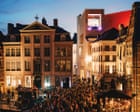
Even its loos have QR codes … the building lit up for its opening party. Photograph: Behangmotief for Design Museum Gent View image in fullscreen Even its loos have QR codes … the building lit up for its opening party. Photograph: Behangmotief for Design Museum Gent Architecture The CO2-absorbing building made of old sinks, windscreens and toilets: Ghent’s £17m design museum is a green marvel Inspired by a gothic cathedral partly built using human bones, this gleaming monument to recycling boasts 62,000 bricks derived from construction waste – each made by the public during a two-day brick-making festival
Oliver Wainwright Tue 20 Oct 2026 09.00 CEST Last modified on Tue 20 Oct 2026 09.14 CEST Share Prefer the Guardian on Google M useums often try to reflect the world around them, but rarely are they made so literally of their surroundings as the new design museum in Ghent . Rising above the Belgian city’s medieval tiled rooftops like an angular white watchtower, the new building has vacuumed up the city’s condemned concrete frames, windows, car windscreens, sinks and old toilets, and transformed them, phoenix-like, into a gleaming monument to recycling.
“There’s nothing new about reuse,” says Andy Groarke, co-founder of Carmody Groarke , the London-based architects who designed the €20m (£17m) project with local firms Atama and Re-st . “We’ve just forgotten how to do it.”
For €10, you can take a brick home from the museum shop He says the team drew inspiration from Ghent’s 16th-century gothic cathedral, Saint Bavo’s, which was partly built using the white limestone blocks of the 10th-century romanesque basilica that had stood on the same site (recent renovations also ghoulishly uncovered walls made of human bones , femurs and tibias apparently having particularly useful structural properties, with crushed skulls for infill).
View image in fullscreen Earthy layers of rubble … Design Museum Ghent. Photograph: Oliver Wainwright The new design museum doesn’t quite go that far in its nose-to-tail approach, but almost. The toilet cubicles are a smorgasbord of “biomaterials”, each featuring different tiles made of seaweed, flax, wood terrazzo and volcanic ash (you can scan a QR code for more info while you’re sitting on the loo). Some walls are plastered with local clay, while a chunky column in the entrance hall revels in its earthy layers of rubble dug straight from the building site.
But the real innovation is the brick , which was specially developed, tested and certified for the project (funded by a grant from Circular Flanders and Sogent, the city’s development agency). Each brick is made of 63% construction waste, sourced from within 8km of the museum, pulverised and compressed with hydrated lime, saving two-thirds of the embodied carbon of a regular fired clay brick. And the lime will continue to absorb CO2 from the atmosphere as it cures over the coming months and years.
“We’re not claiming this is a panacea, or a solution to the climate crisis,” says architect Sian Ricketts, Carmody Groarke’s sustainability lead. “But it is a sort of 82,000-brick proof of concept that you can do something different, with the right collaborators and the right clients.” Developed by East Sussex firm Local Works Studio and Brussels group BC Materials , the bricks were made in a former railway depot nearby, with the public invited to mix the ingredients and press their own blocks during a two-day festival of brickmaking. For €10, you can take one h…