
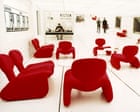
Olivier Mourgue’s Djinn chairs furnishing the lobby of the Hilton hotel orbiting the moon on Space Station V in Stanley Kubrick’s 1968 film 2001: A Space Odyssey. Photograph: Collection Christophel/Alamy View image in fullscreen Olivier Mourgue’s Djinn chairs furnishing the lobby of the Hilton hotel orbiting the moon on Space Station V in Stanley Kubrick’s 1968 film 2001: A Space Odyssey. Photograph: Collection Christophel/Alamy Design Obituary Olivier Mourgue obituary Designer whose flexible furniture for informal 60s living gave a futuristic look to Kubrick’s 2001: A Space Odyssey
Prefer the Guardian on Google Olivier Mourgue always wanted to design the future. Growing up in Paris in the 1950s, he took against the ornate antique furniture of his parents’ apartment, the formality of a dining room with a table surrounded by elaborately uncomfortable chairs and a living room dominated by a sofa used only on special occasions. “Furniture like that has nothing to do with life,” he would suggest later. “One is never at ease in such rooms.”
Mourgue, who has died aged 87, set out to design furniture that belonged to the modern world, and blurred the boundaries between furniture and architecture. In his view, that meant that it should be flexible, informal, affordable and as close to the floor as possible. He succeeded in a way that he could not have expected.
The film director Stanley Kubrick made Mourgue’s designs an essential part of popular culture’s expectations of how the future would look, even though Mourgue’s work was produced by the thousand rather than in millions. Kubrick used a cluster of Mourgue’s Djinn armchairs to equip the lobby of the Hilton hotel orbiting the moon on Space Station V for one of the key scenes of 2001: A Space Odyssey. The Djinn seemed to float almost weightless, like a colourful bubble of air. There were no conventional arms or legs to be seen. Instead there was a lightweight steel structure and some sturdy rubber webbing to support the foam upholstery, all hidden inside a seamless surface.
Kubrick had a preternatural gift for finding what might be called “real” objects, such as Djinn, from his own time, that seemed to belong to the future. He used them to give a sense of authenticity to his sets. Kubrick filmed A Space Odyssey in 1968, when Djinn looked entirely at home in a plausible version of 2001 that did not yet exist. Almost 60 years later, Djinn still looks like a version of the future, fluid and colourful, covered with a specially made stretch fabric that was available in 15 different bright colours and light enough to carry under your arm.
View image in fullscreen Olivier Mourgue lived in later life in Brittany, where he taught at the École des Beaux Arts in Brest. Photograph: Armel Mourgue Mourgue wanted to do more than change the way that things looked. He believed in designing furniture that reflected the way that people want to live. He created a low-cost range of mass-produced designs for the department store chain Prisunic, in the days when it was a French version of Ikea, selling through its catalogue as well as its network of stores. The 1969 Prisunic edition launched a collection that Mourgue described as “bringing beauty at the price of the ugly”. It included bookcases, beds, tables, and seating made from lightweight chipboard that could be easily dismantled if required. One piece was a floor-cushion seat with raised edges that formed a place to sit.
Mourgue was born in Paris, to Den…