
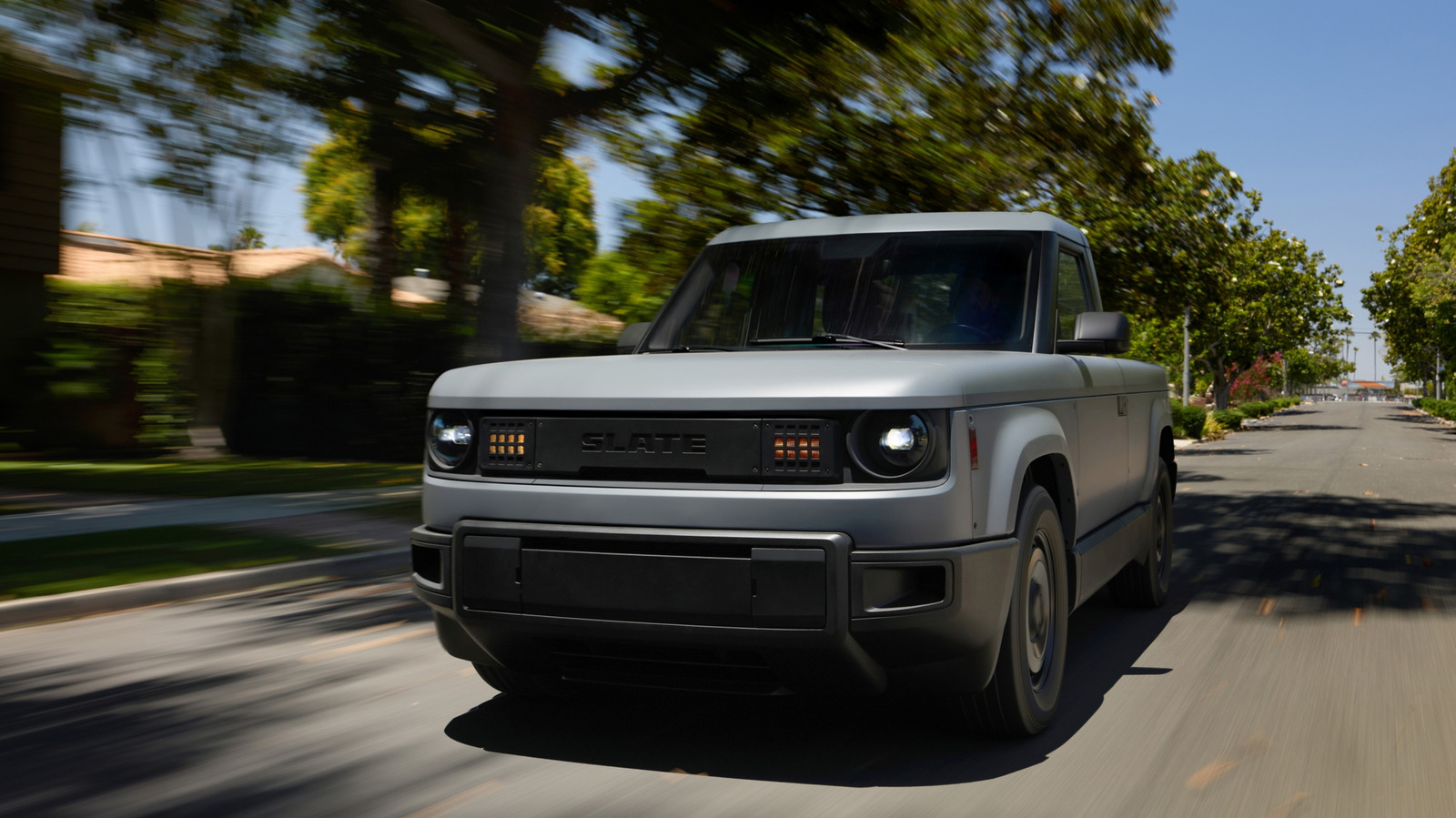
Slate Add Engadget on Google: Preferred Source Google Discover Slate is bringing something new to the EV truck market. The truck startup has quickly made a name for itself with its minimalist design, low price point and customization features . Playfully crowned the Blank Slate, the Michigan-based manufacturer's flagship truck does away with pesky features like speakers and automatic windows in favor of a $24,950 base price. But even with hundreds of add-ons and vinyl wraps, the build-your-own truck company is hoping that the biggest roadblock to getting you in an EV is the market's elevated prices.
Luckily, the company's minimalist approach doesn't apply to the truck's performance. With a 135 kW motor, the EV delivers 181 horsepower, 195 ft-lb of torque and 2,000 pounds of towing power. These metrics are in line with the hybrid Ford Maverick. And while its 205-mile range leaves something to be desired , the biggest concern for trucking purists may be the Slate truck's commitment to two-wheel drive.
Slate, which has pitched its truck more as an everyday vehicle than a heavy-duty towing machine, currently only offers rear-wheel drive. However, this may change with later models. According to an email posted to the Slate truck fan forum , "all-wheel drive is in the plans for a future version of Slate." According to the post, although such options won't be available at launch, Slate knows "how important it is for folks in snowier climates, on job sites, or looking for that extra traction."
Of course, such projections should be taken with a grain of salt. To date, Slate has yet to verify whether a different drivetrain is in the works. We've reached out to Slate for confirmation and will update the story accordingly. In the meantime, let's look at how Slate drivers can benefit from all-wheel drive, and why Slate has chosen not to offer it at this time.
Slate The desire for four-wheel drive and all-wheel drive options is logical. Because these drive systems send power to each wheel, they can maximize control and improve traction when driving in uncertain conditions. So if you plan on camping in the woods, need to haul large payloads over unpaved roads or expect to be driving in slick conditions, a truck with 4x4 or all-wheel drive is worth considering.
But Slate's decision to use a rear two-wheel drivetrain is also sound. First and foremost is cost, as adding AWD or 4WD substantially raises a vehicle's price tag. Considering Slate's mission to deliver "the most affordable truck in America," using rear-wheel drive is an easy way to lower costs. Moreover, AWD and 4WD drivetrains typically increase maintenance costs. The extra energy expenditure of powering all four wheels can also decrease an EV's range, potentially exacerbating an already-acute challenge for Slate drivers. Rear-wheel drive also offers more towing capacity, adding to its case as a more efficient option for the EV.
Rear-wheel drive also better fits Slate's audience. Notably, the startup doesn't market its trucks as heavy-duty haulers or off-roading demons. Instead, Slate argues that its trucks are "built for everyday practicality," with the company stating that its drivetrain strikes a balance between battery range, towing performance, traction, stability and thermal limits.
These considerations are notable given the peculiarities of EV towing. Capable of generating max torque instantly, EV trucks are great for low-speed hauling. However, Slate's website notes that "sustai…