
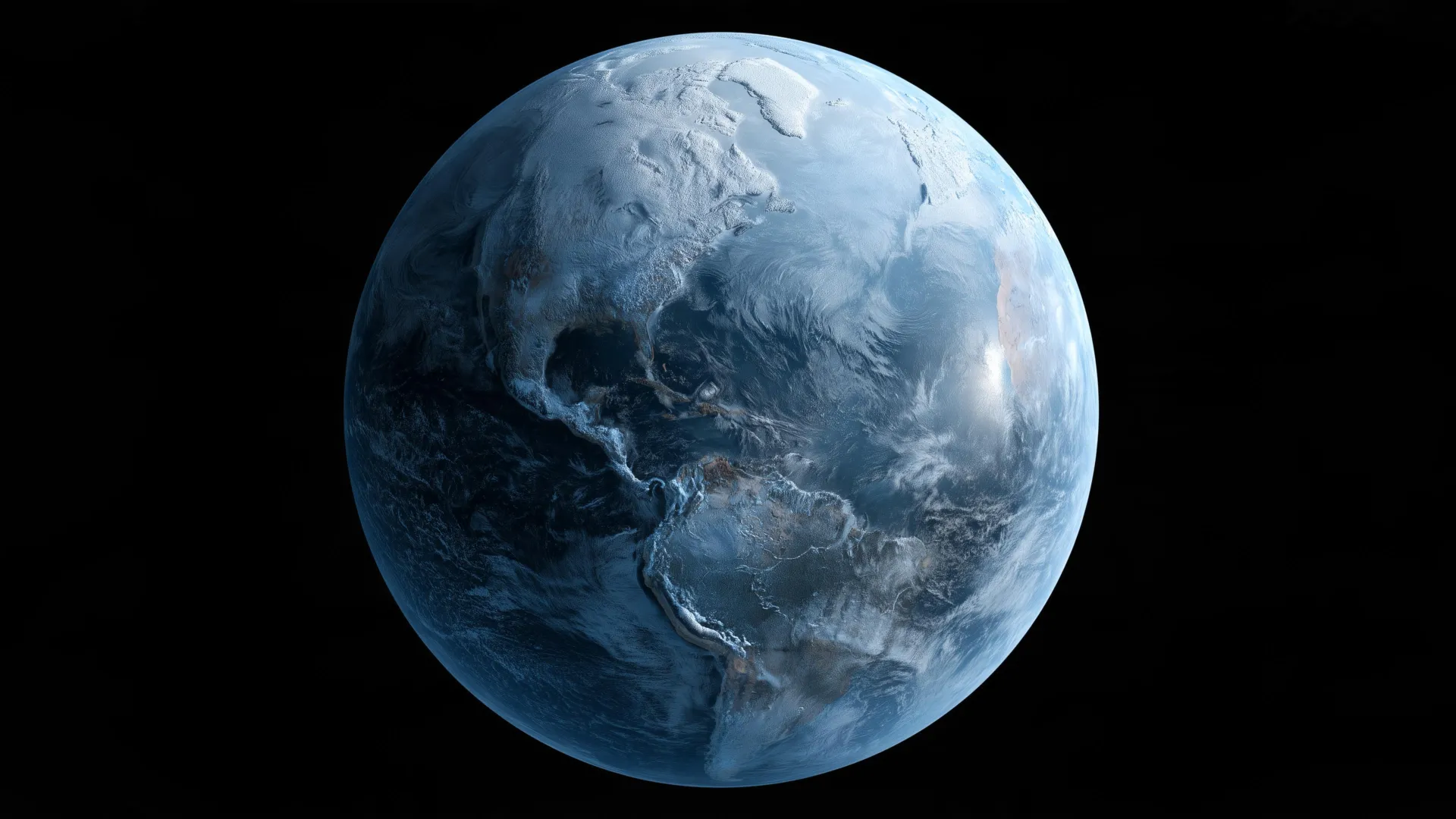
Scientists at the University of St Andrews have identified a previously unknown process that may help explain how Earth entered past ice ages. Their findings reveal a surprising connection between ice sheets in the Northern Hemisphere and ocean changes near Antarctica, suggesting that cooling in one part of the world could trigger a chain reaction affecting the entire planet.
The study, published in the Journal of Climate , offers a possible explanation for how growing northern ice sheets influenced ocean circulation and sea ice in the Southern Hemisphere. These southern changes are known to help reduce atmospheric carbon dioxide (CO 2 ), an important factor in the development of ice ages. Until now, scientists have struggled to explain how processes occurring at opposite ends of the planet could be so closely connected.
One of the main forces behind Earth's past ice ages was a reduction in atmospheric CO 2 as more carbon became stored in the oceans. Much of this process was controlled by changes in the Southern Ocean surrounding Antarctica. However, a major question remained unanswered: How could expanding ice sheets in the Northern Hemisphere, initially driven by natural variations in Earth's orbit, cause the distant Southern Ocean to absorb more CO 2 ?
How Northern Ice Sheets Could Trigger Changes Near Antarctica
The researchers propose that the answer lies in the movement of ocean water between the hemispheres. As large ice sheets spread across northern regions, they cool nearby waters in the North Atlantic. Over time, these colder waters circulate southward, eventually reaching the Southern Ocean.
If the cooling is sufficiently strong, it could alter ocean circulation around Antarctica in ways that allow more CO 2 to be stored beneath the ocean's surface. As atmospheric CO 2 declines, the planet cools further, potentially helping intensify an ice age.
To investigate this possibility, the team used computer simulations of ocean circulation. Rather than lowering temperatures across the entire planet, they cooled only the northernmost latitudes (mimicking the effect of a large ice sheet) and examined how the Southern Ocean responded.
The results were striking. Cooling the far northern regions alone produced 74% as much CO 2 drawdown as a separate simulation in which the entire planet was cooled. This suggests that temperature changes in the Northern Hemisphere could have a powerful influence on the Southern Ocean and its ability to store carbon.
A Missing Link in Earth's Ice Age Mystery
The simulations provide strong support for the proposed connection between expanding northern ice sheets and changes in the Southern Ocean. They suggest that colder water originating in the North Atlantic could eventually influence circulation around Antarctica, helping remove CO 2 from the atmosphere and contributing to the global cooling associated with past ice ages.
For decades, much of the research into ice age climate changes has concentrated on the Southern Ocean because of its important role in controlling atmospheric carbon dioxide. Only more recently have scientists begun to recognize how changes in distant ocean regions might influence these processes.
Lead author Dr. Madison Shankle, from the University of St Andrews School of Earth and Environmental Science, explained the importance of the findings:
"Essentially, we've produced evidence of a plausible mechanism connecting these two far-flung puzzles pieces - Northern Hemisphere…