
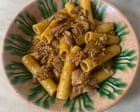
Rachel Roddy’s pasta with Senegalese-inspired ragu. Photograph: Rachel Roddy/The Guardian View image in fullscreen Rachel Roddy’s pasta with Senegalese-inspired ragu. Photograph: Rachel Roddy/The Guardian A kitchen in Rome Italian food and drink Rachel Roddy’s pasta with Senegalese-inspired ragu – recipe A historical adventure deep in the very heart of pasta country in southern Italy unexpectedly unearths a sauce with roots in Senegal
Rachel Roddy Thu 29 Oct 2026 07.00 CET Share Prefer the Guardian on Google A bout 30 kilometres south of Naples, the town of Gragnano is surrounded by the Monti Lattari mountain range – the limestone backbone of the Sorrento peninsula. Historically, a series of natural springs fed into a larger stream called Vernotico, which flowed down the mountainside, passing through what was at the time the small village of Gragnano.
The natural slope of the terrain was fortuitous, because it allowed for the construction of a sequence of mills, which started in around 1263. During a visit to Gragnano last month, local historian Giuseppe Di Massa explained how it all worked; how gravity drove the flow of water from one mill to the next, in order to power vertical millstones – a system created for the inconsistent flow. The valley, with its clever water system, became known as the valley of the mills; its role milling grain, which arrived at the nearby port of Castellammare di Stabia, a vital operation to Naples and surrounding towns.
The activity of the 30 mills peaked during the 18th century, but another industry was growing, one that harnessed another natural aspect of the town: its climate. The temperature, humidity and sea breeze were ideal conditions for drying pasta.
Often in strings hung over wooden frames, pasta was dried in the streets of Gragnano, then moved inside when necessary; the skill of the pasta makers and their ability to harness the weather every bit as important as the weather itself. And the industry grew. According to the city of Gragnano website, by 1859 there were 81 pasta factories, requiring ever increasing amounts of hard durum wheat for their pasta, while the mills produced soft wheat. The mills ceased operations in the 1950s, and were largely abandoned until renovation projects turned some of them into small museums.
What has continued to grow in Gragnano, though, is the tradition and art of pasta making; now with its own Indicazione Geografica Protetta, which protects its quality (provenance of wheat, how it is extruded, how long it is dried) and connection with the region. These days, 23 producers – from tiny to vast, 15 of which make up a consortium – make more than 100,000 tonnes of pasta annually in carefully controlled conditions – conditions very different from the open streets, but requiring just as much skill. I returned to Rome with bags of pasta from seven different makers – Di Martino, Faella, Garofolo, Liguori, Afeltra, Antiche Tradizioni di Gragnano, Ducato di alfalfi – all of which pleased me with their nutty scent, porous texture and resilience in the pan.
I also came back from Gragnano with a recipe devised for the town’s Mondopasta festival this year by chef Astou Ndiaye. Born in Dakar and now living with her family in Milan, Ndiaye’s cooking draws both on her heritage and her home. For her beautiful Senegalese ragu, the meat (I used lamb) is marinated in an aromatic blend of vegetables, coriander and cloves before being braised for a stew soft enough to be pasta sau…