
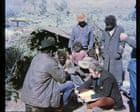
The photo of Geoffrey Barden and some of the painting men (and a child) that first caught Kitty Hauser's attention. Photograph: courtesy of Dorn Bardon View image in fullscreen The photo of Geoffrey Barden and some of the painting men (and a child) that first caught Kitty Hauser's attention. Photograph: courtesy of Dorn Bardon Art ‘A whitewashing of minds’: the mania and myth of Geoffrey Bardon and the painting men of Papunya Bardon has largely remained in popular consciousness as the synonymous hero and martyr of the art movement’s origin story. But a new biography is unravelling the myth, and the madness, behind the tale
Like many foundation stories, the white Australian narrative about the birth of the globally celebrated Western Desert Aboriginal “dot painting” movement is steeped in myth.
For decades it has gone like this. In 1971 a young, eccentric middle-class art teacher from Sydney, Geoffrey Bardon, arrives in the remote assimilationist Aboriginal settlement of Papunya, 250km west of Alice Springs.
At the settlement, made up of disparate desert peoples (Warlpiri, Pintupi, Luritja, Anmatyerr, Arrernte and Pitjantjatjara), Bardon meets a group of men including Clifford Possum, Charlie Tarawa, Mick Namarari Tjapaltjarri, Tim Leura Tjapaltjarri, Kaapa Tjampitjinpa and Maxie Tjampitjinpa.
He convinces the men to paint on hard surfaces the “dreaming’’ stories they had hitherto only committed with fingers to sand and ceremonially on to one another’s bodies, beginning with an expansive mural of honey ants on the external school wall.
View image in fullscreen The honey ant mural being painted, 1971, footage by Geoffrey Bardon (from Mr Patterns). Bardon starts to sell their works. In so doing he not only conceives the western desert painting school but also a voracious global market for what the critic Robert Hughes called “the last great art movement of the 20th century’’. The men will later become known as the celebrated Papunya “painting men’’ . But Bardon meets impossible opposition from the white assimilationist authorities to the point where he must flee Papunya with his physical and mental health in tatters. He never works again.
In death at 62 in 2003 Bardon has largely remained in popular and internet consciousness (if not that of the 21st-century art academy) as the synonymous hero and martyr of the Papunya – and, more broadly, Western Desert – art movement’s origin story.
But a new biography – Art Mania: Geoffrey Bardon and the Painting Men of Papunya by Kitty Hauser – brings extraordinary new understanding to the teacher and his somewhat culturally parasitic older barrister brother, James (“Jim’’) Bardon.
Art Mania is more than a biography of “Geoff’’, as Hauser calls him, and his role in the emergence of the Western Desert painting movement. It is also partly about Jim, who used his younger brother’s year or so at Papunya from 1971 as his own creative fodder for two novels (including the critically acclaimed 1991 novel, Revolution by Night, which won the Victorian premier’s literary award for new writing), film documentaries, and numerous articles and speeches he penned for Geoff.
View image in fullscreen Author Kitty Hauser at her home in Earlwood, NSW. Photograph: Blake Sharp-Wiggins/The Guardian In the book, Hauser concludes of the elder brother: “Jim got a fair bit of literary mileage out of the painting men, or his idea of them. There could hardly be a better example of appropriation, even if it has gone under…