
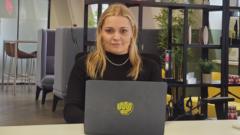
Image source, Lotte Underwood Image caption, Managing AI agents is a big part of Lotte Underwood's job
Recent university graduate Lotte Underwood is a public relations executive with a twist - she spends more time using AI than actually doing PR.
Underwood, 25, joined London-based PR agency Fight or Flight in November last year, in the new role of "AI associate" after completing a degree and then a masters in marketing.
She's part of a recently established, dedicated AI team that has built around 30 AI agents. Specific tasks include industry research, client reporting, media interview preparation, helping clients create clearer briefs, and image generation.
A big part of Underwood's job is to manage those agents, check their outputs and feed those to the team members who are dealing directly with clients and the media.
Another key responsibility of hers is to monitor how clients appear in the responses from AI tools like ChatGPT, Claude, Gemini and others.
"A huge part is being in client meetings and calls to work out what is actually going to be most helpful from these agents," says Underwood.
AI is seen as one of the main factors behind graduate job cuts , but companies are also creating dedicated AI-specific graduate roles like Underwood's.
Dillan Patel, for example, joined engineering software company Stride 18 months ago as an intern. A business management graduate, he was put to work developing an internal chatbot designed to capture the knowledge of a senior staff member transitioning into retirement.
Patel, 24, is now an AI automation analyst, tasked with developing further internal agents to provide specific information to individual teams, while also identifying which manual or repetitive tasks across the company could be done by AI.
"My role focuses on finding practical ways to use technology, automation, data and AI to improve how we operate," says Coventry-based Patel.
Image source, ArvatoConnect Image caption, Debra Maxwell is looking for "AI disruptors"
Such AI savvy graduates are also in demand from companies like ArvatoConnect, an outsourced contact centre company.
CEO Debra Maxwell says the company's usual graduate intake is on hold this year, but she plans to resume it next year with a bigger focus on AI.
"We would be looking for more AI-disruptor type roles, where you can challenge us as an organisation to think more holistically about where AI can be applied and where we could grow our business from," says London-based Maxwell.
"We see our graduates as not filling administrative roles, but actually adding value to the organisation in a different way."
Maxwell adds: "For example, one of our recent graduates is using AI to do deep dives on specific markets, and provide more information for when we're bidding [for new contracts]. It's basically giving him a more rounded role."
If AI can make a graduate job bigger and more integral to the organisation, Maxwell argues that companies can create a more loyal, engaged workforce that is able to contribute more meaningfully, much earlier.
Research from consultancy PwC found that some graduate roles are assuming more responsibilities because of AI, as it allows companies to demand more senior abilities from junior hires.
For the consultancy's 2026 AI Jobs Barometer , external , it analysed 2.4 million entry-level jobs in the US. It found that the entry-level roles most influenced by AI are now seven times more likely t…