
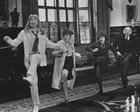
The Ruling Class, 1972, directed by Peter Medak, with from left: Peter O’Toole, Kay Walsh, Patsy Byrne and Arthur Lowe. Photograph: John Springer Collection/Getty Images View image in fullscreen The Ruling Class, 1972, directed by Peter Medak, with from left: Peter O’Toole, Kay Walsh, Patsy Byrne and Arthur Lowe. Photograph: John Springer Collection/Getty Images Film Obituary Peter Medak obituary Film and television director who won plaudits for The Ruling Class, The Changeling and The Krays
Prefer the Guardian on Google In 2013, when Martin Scorsese compiled a brief list of his favourite horror films, he placed the eerie and overlooked 1980 ghost story The Changeling in the company of classics such as The Shining, The Exorcist and Psycho. Scorsese called it a “haunted house movie filled with sadness and dread”; Guillermo del Toro called it “a masterpiece”. Its director was the versatile British-Hungarian film-maker Peter Medak, who has died aged 88.
The Changeling concerns a composer ( George C Scott ) who is grieving the deaths of his wife and daughter in a road accident. After moving into a long-vacant Seattle mansion where things start going bump in the night, he becomes convinced that a spectral presence is trying to communicate with him.
A generation raised on slasher films might now be underwhelmed by the low-key frights, which include a bath that runs itself, a cobwebbed wheelchair and visions of a child’s face warped underwater. But with its subtlety and patience, and the prioritising of atmosphere over revelation, the movie remains chilling today.
View image in fullscreen Peter Medak on the set of A Day in the Death of Joe Egg, 1972. Photograph: RGR/Alamy It represented a rare foray into horror for Medak, who was already admired for The Ruling Class (1972), a madcap satire starring an Oscar-nominated Peter O’Toole as an aristocrat who believes himself to be Jesus Christ. The critic Janet Maslin identified in the director a “droll affinity for eccentric behaviour”.
Medak later crafted two stylised visions of British postwar criminality. In The Krays (1990), the brothers Gary and Martin Kemp, of the pop group Spandau Ballet, were impressive as the Kray twins, Ronnie and Reggie. Support came from some of the best in the business: Billie Whitelaw as the twins’ formidable mother, Kate Hardie as Reggie’s tortured wife, and Tom Bell and Steven Berkoff as fellow hoods who meet a grisly end. Philip Ridley’s script, hauntingly dream-like at times, was directed by Medak with flair and lucidity.
View image in fullscreen Martin and Gary Kemp in The Krays, 1990. Photograph: Warner Bros./Sportsphoto/Allstar In an unusual move, the Krays (including their brother Charlie, who was credited as a “technical assistant”) were paid handsomely. That did not stop Ronnie from loathing the film. “You had my mum swearing in it and she never swore,” he complained.
The Krays was followed by Let Him Have It (1991), which dramatised the case of Derek Bentley (Christopher Eccleston), who was hanged in 1953 for the fatal shooting of a police officer even though he did not pull the trigger. (The conviction was quashed in 1998.)
Medak’s childhood was as dramatic as anything in his films. He was born in Budapest, to Elisabeth (nee Diamounstein), who worked as a seamstress, and Gyula Medák, who ran a textile company and was eventually imprisoned as a capitalist in the late-1940s communist takeover of Hungary .
One Saturday lunchtime in June 1944, when Pet…