
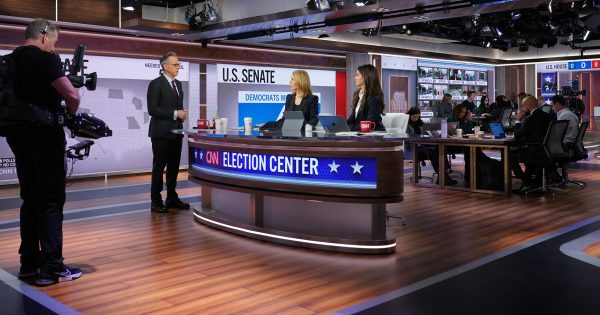
CNN Election Center on Tuesday night. [Left to right: CNN Anchors Jake Tapper, Dana Bash and Kaitlan Collins] Courtesy of CNN By Mark Mwachiro --> As the dust settles from a historic midterm election that saw the Democratic Party surf a blue wave to capture both the Senate and the House, news outlets are downshifting from special coverage and settling back into regular programming.
With 31 million viewers tuning in Tuesday night across 13 networks, TVNewser recently spoke to NBC News’ evp, creative, innovation & field production Marc Greenstein , whose network was the No.1 network during primetime in total viewers and the Adults 25-54 demo, as well as CNN’s svp, Washington & special events programming Abigail Crutchfield , whose network was the most-watched cable news network in the prized demo, and NewsNation’s political director Chris Stirewalt , whose network in coordination with Decision Desk HQ was the first one to call both the House and the Senate for the Democrats, for a post-election AskNewser on what worked well during their live election coverage.
TVNewser: What worked well from a coverage and technology standpoint on election night?
Greenstein : Steve Kornacki continues to be the best at breaking down the vote, providing context and helping viewers understand not just what is happening, but where the night is headed.
We combined editorial and technology in a new way, allowing Steve to contribute to the linear broadcast while simultaneously hosting his own dedicated streaming feed from the same studio as Savannah Guthrie and Tom Llamas . This allowed us to produce two distinct broadcasts just feet apart, each tailored to its audience, without losing the editorial connection between our talent.
Extensive planning for multiple election scenarios allowed us to react quickly as race calls came in. We deployed multiple correspondents across nearly every battleground state, covering both voting developments and candidate headquarters. This gave us a strong presence in the places driving the story and allowed us to bring firsthand reporting and reaction into the broadcast throughout the night.
We played more than 35,000 graphics across our zones and platforms, delivering results and analysis with speed and clarity. We brought together broadcast, streaming and digital coverage under a consistent editorial and visual approach, while tailoring the experience to each platform. The launch of our dedicated vertical video feed was another important step in reaching audiences in new ways without compromising the depth or quality of our journalism.
Cruthchfield : It was having all of our experts and talent together in one place. It gave the DC bureau great energy, and it was fun to watch the reporters and anchors work together to unpack the results.
Our director, Reza Baktar , designed a phenomenal set that gave us more mobility than ever and made it easy to get to any data set we needed at any moment. I also loved giving John King the ability to analyze the data at the magic wall or to bring his mini magic wall over to our analyst tables to be a part of the conversation. And I loved King’s new vertical magic wall, which opened up new storytelling options.
Stirewalt : You can’t beat the cards. We had such an advantage by having Decision Desk HQ (DDHQ) on our side. I think we did a good job of bringing viewers into the process and explaining what we were doing, but when you get down to it, the advantage of being so far ahead of the c…