
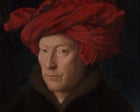
‘Jan van Eyck made me on 21 October 1433’ … Jan van Eyck, Portrait of a Man (Self Portrait?), 1433 Photograph: National Gallery, London View image in fullscreen ‘Jan van Eyck made me on 21 October 1433’ … Jan van Eyck, Portrait of a Man (Self Portrait?), 1433 Photograph: National Gallery, London Jan van Eyck Tricks! Traps! Riddles! Jan van Eyck’s portraits look vividly real – but are full of secret messages. What do they mean? The more you gaze at these 10 surviving works, with their cryptic inscriptions and even fool’s gold, the more the Flemish master trips you up – but being laughed at like this is all part of the glorious pleasure
Van Eyck: The Portraits review – a jewel box of phenomenal death-defeating paintings
Charlotte Higgins Thu 19 Nov 2026 06.00 CET Share Prefer the Guardian on Google A t the Barbican Art Gallery in London, there is an exhibition of some of the white paintings made by the US artist Robert Ryman over 60 years from the 1950s. The paintings are square, because a square is neutral, and he didn’t want viewers associating them with the visual language of landscape or portrait. For Ryman, his paintings resolutely were what they were, which is to say, white paint applied to various surfaces and fixed to the wall. Not “windows” through which one could glimpse another world.
At the National Gallery , a couple of miles across town, is an exhibition of 10 works by the 15th-century Flemish painter Jan van Eyck. With one exception – the Arnolfini portrait, which is a one-off in all kinds of ways – they are all A4-size portraits, each angled so that we see more of the left than the right side of their faces. Aside from the likenesses of the people who paid for them in some of his religious paintings, including the Ghent altarpiece, these are the sum total of Van Eyck’s surviving portraits.
In a manner profoundly different from Ryman’s works, Van Eyck’s portraits pull you from our world into his. The precision of his physiognomies is dizzying. In his portrait of his wife, Margaret, recently conserved and on loan from Bruges, she regards you with a steady gaze, her lips firm and decisive. Between her cheek and ear is a blemish, a slight discolouring of the skin; her left eyebrow is bisected by a scar. Her headdress contains seven layers of frothing lace that you want to pinch between your thumb and finger. What must it have been like, to look back at this vision of yourself, in a world in which mirrors were luxury items (and mostly convex, like the one that famously hangs at the back of the Arnolfini portrait)?
View image in fullscreen ‘What must it have been like to look back at this vision of yourself?’ … Jan van Eyck, Margaret, the Artist’s Wife, 1439 Photograph: National Gallery, London/Municipal Museums Bruges, Groeningemuseum We know it’s her, because a very detailed inscription in the painter’s hand on the original frame tells us that “my husband Jan completed me on 15 June 1439” and that “my age is 33 years”. By some stroke of painterly enchantment, is it Margaret herself addressing us? Or is the “me” the painting – a mere arrangement of oil paint on a panel of Baltic oak? The inscription concludes with the words “as I can” – Van Eyck’s motto, a phrase that hovers between extreme modesty and great boastfulness.
All the portraits have something of this uncanny hyper-realistic quality. The pockmark on the slightly shiny, reddish young skin. The lines around the eyes and crinkled cheeks of the old scholar in hi…