
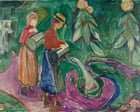
Girls Watering Flowers is one of 12 canvases created by Edvard Munch for the walls of the women’s canteen at the Freia chocolate factory in Oslo. Photograph: Halvor Bjørngård/Edvard Munch View image in fullscreen Girls Watering Flowers is one of 12 canvases created by Edvard Munch for the walls of the women’s canteen at the Freia chocolate factory in Oslo. Photograph: Halvor Bjørngård/Edvard Munch Culture Edvard Munch and the Chocolate Factory: the bitter truth behind the Freia frieze New exhibition in Oslo connects artist’s 1922 public work with the history of cocoa, the labour movement and women’s emancipation
Miranda Bryant in Oslo Wed 15 Jul 2026 23.49 CEST Last modified on Thu 16 Jul 2026 01.13 CEST Share Prefer the Guardian on Google A t first, to be among Edvard Munch ’s Freia frieze is almost to be swept up by a dance. Across the 12 canvases on display at Oslo’s Munch museum, fruit pickers’ arms reach with balletic poise, water flows from watering cans in unison, farewells are dramatically bid and synchronised couples move across a beach arm in arm. Even Munch’s brushstrokes, dominated by blues and greens, cannot sit still.
But as you start to ponder why these scenes – commissioned in 1922 as public art to decorate the walls of the women’s canteen at the factory for renowned Norwegian chocolate company Freia – were created, the urge to move evaporates.
Public art is often viewed in an almost noble light. How fantastic that the creator of the world-famous The Scream also wanted to make art for factory workers! But were the needs of the girls and women who worked in the chocolate factory – then often referred to as the “chocolate girls” – actually on the minds of their employer, or even Munch, when this was created?
“Those years when Munch was working on the Freia frieze were very dramatic and dark for the whole of Europe, especially after the first world war,” says curator Ana María Bresciani, who, through the exhibition – titled Edvard Munch and the Chocolate Factory – uses the frieze to tell the wider story of workers’ rights and the fight for gender equality. It also touches on the violent, exploitative and racist history of Freia’s cacao sourcing – which came first from South America and the Caribbean, and later from Ghana, at the time a British colony – and its marketing.
The exhibition marks the first time that the frieze – which is on loan to the museum until October while Freia’s canteen undergoes renovations – has gone on display in Norway outside the factory, and only the second time it has left the factory at all (it was previously exhibited in 1968 at the National museum in Stockholm). The production of Freia’s chocolate ( which claims to provide “a little piece of Norway”) is still largely based in Oslo, but the company is now owned by US food giant Mondelēz International.
Read more The frieze first arrived at the factory in 1923 at a pivotal time for Norwegian workers rights. Around this time they won the right to an eight-hour day and summer holidays, but, says Bresciani, many of the girls and young women would not have had experience of the kinds of scenes Munch depicts. “I don’t think they had access to summer cottages, they probably didn’t have access to swimming and they probably didn’t have much access to art just yet.”
View image in fullscreen Four Girls in Åsgårdstrand (The Freia Frieze IX). Photograph: Halvor Bjørngård/Edvard Munch Munch appears not to care about any of this. In fact, perhaps, this w…