
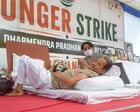
Sonam Wangchuk during his hunger strike at Jantar Mantar, Delhi. Photograph: Amrit Dhillon View image in fullscreen Sonam Wangchuk during his hunger strike at Jantar Mantar, Delhi. Photograph: Amrit Dhillon Global development ‘I’m sorry but I’m unable to speak’: hero of India’s Cockroach party weakens on 19th day of hunger strike The climate activist and engineer Sonam Wangchuk, who has become the figurehead of anti-government protests in Delhi, is resisting calls to end his fast until the education minister resigns
About this content Amrit Dhillon in Delhi Fri 17 Jul 2026 05.00 CEST Share Prefer the Guardian on Google A s night falls on day 18 of his hunger strike, the lack of any sustenance except water shows. It is 7pm and Sonam Wangchuk looks weak. A physiotherapist sits beside him on the stage massaging his arms to soothe his aching joints. Propped up against pillows and bolsters, Wangchuk whispers: “I’m sorry, but I’m unable to speak.”
The activist and engineer has lost close to 9kg from a body that was spare and lean to begin with. Doctors say it is around this stage of a hunger strike that the body enters a state of severe starvation, breaking down fat and muscle, resulting in extreme weakness, impaired brain function and electrolyte imbalance.
On Thursday, as day 19 arrived, an Indian court ordered authorities to monitor Wangchuk’s health.
He was not really meant to be here, on this improvised stage, lying under an awning in an unbearably hot and humid capital. It’s a long way from home in the icy cold Himalayan region of Ladakh where he is known for campaigning on the climate crisis. Yet, by starting the hunger strike, Wangchuk has become the beating heart of India’s latest protest movement, the Cockroach Janta party , or CJP. Its demand is the reform of a soul-destroying education system and the resignation of the education minister, Dharmendra Pradhan.
Two million students were devastated when a key nationwide exam to enter medical college was cancelled in early May after a paper was leaked . A dozen students were reported to have killed themselves, unable to face sitting it a second time.
The CJP was founded on 16 May by 30-year-old Abhijeet Dipke. He was in the US looking for a job when the chief justice of India called some unemployed youths “cockroaches”. Dipke embraced the cockroach tag and urged others to do so, and the movement rapidly gained popularity as a platform for young Indians.
View image in fullscreen A protester in Mumbai sketches Wangchuk, 16 July. Photograph: Indranil Aditya/NurPhoto/Shutterstock Since 6 June, the CJP and its followers have been camping out at Jantar Mantar, a popular protest site in Delhi. Supporters have been drawn from all over India – students, senior citizens, social media influencers, academics and parents – all furious with an education system that forces children to study 10-14 hours a day and have the rest of their lives determined by a single three-hour test.
Most of the middle-class families who turn up at Jantar Mantar are not politically active. But they have been bringing cooked food, biscuits, bananas and water to keep the protesters going in temperatures upwards of 37 degrees.
No one in the Narendra Modi government has engaged with the protesters.
“Why won’t they talk to us?” asks the CJP national spokesperson Ashutosh Ranka. “Don’t they know they are servants of this country who are meant to be accountable to the people?”
Anish Gawande, a young and upcoming oppo…