
Science Northern Lights Could Be Visible From 10 States Overnight Tuesday By Jamie Carter ,
Forbes contributors publish independent expert analyses and insights. An award-winning reporter writing about stargazing and the night sky. Follow Author Jul 20, 2026, 09:00pm EDT Summary The Northern Lights could be visible across northern U.S. states this week, fueled by a fast solar wind from a recurrent coronal hole, not a coronal mass ejection. A G1-class minor geomagnetic storm is anticipated late Tuesday, July 21, into Wednesday, July 22. States including Washington, Montana, and Michigan, particularly near the Canadian border, are potential viewing areas. However, short summer nights, a first-quarter moon, and light pollution may challenge visibility. Skywatchers should find dark locations and look north, as the aurora's intensity also hinges on the solar wind's magnetic field orientation. Looking ahead, space weather forecasts are expected to significantly improve by 2027 with ESA's HENON CubeSat, offering extended warning times for geomagnetic events.
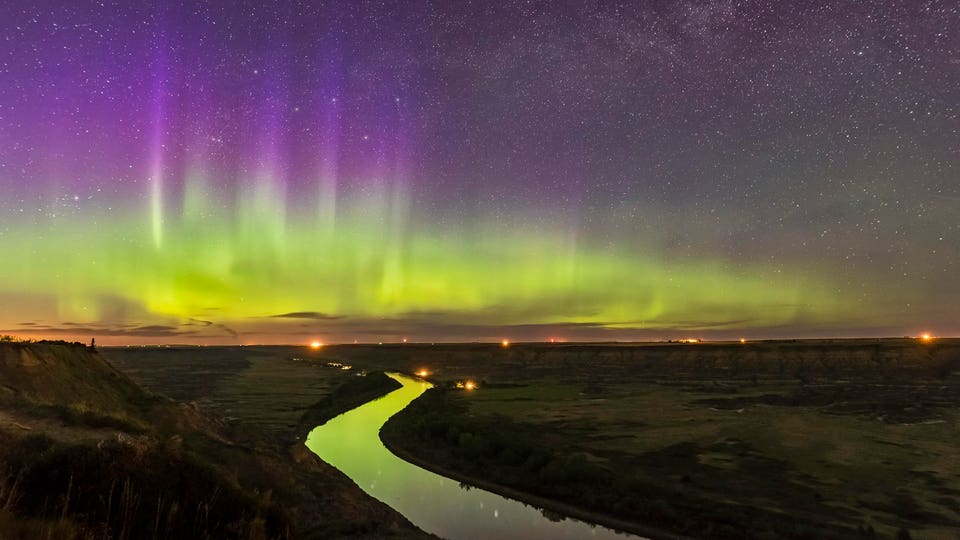
Geomagnetic activity is expected to increase late on Tuesday, July 21 and continue into Wednesday, July 22. A G1-class, or minor, geomagnetic storm is considered likely. (Photo by: Alan Dyer/VW Pics/UIG via Getty Images) Universal Images Group via Getty Images The northern lights could become visible across parts of the northern U.S. this week as a fast-moving stream of solar wind from a large coronal hole reaches Earth.
Unlike some of the strongest aurora displays of recent years, this week’s event is not being driven by a coronal mass ejection. Instead, forecasters are monitoring a recurrent coronal hole, an area where the sun’s magnetic field opens into space and allows faster solar wind to escape.
Geomagnetic activity is expected to increase late on Tuesday, July 21 and continue into Wednesday, July 22. A G1-class, or minor, geomagnetic storm is considered likely, potentially bringing aurora into view from northern-tier U.S. states close to the Canada border.
The short summer nights (and this week’s first quarter moon ) may make faint aurora harder to see, with lingering twilight reducing the contrast required to spot a glow low on the northern horizon. The forecast comes as noctilucent clouds are being seen in the northern hemisphere, and a comet brightens .
According to a forecast by space weather experts at the National Oceanic and Atmospheric Administration, “By late on 21 Jul, unsettled to active conditions are likely, with a chance for G1 (Minor) levels near the end of the period. By 22 Jul, unsettled to active periods are expected, with G1 (Minor) storm levels likely as the negative CH HSS moves into a geoeffective position.” A CH HSS is a coronal hole high-speed stream, a flow of fast solar wind that can disturb Earth’s magnetic field when it reaches a favorable, or geoeffective, position.
The UK Met Office’s Space Weather Operations Center is forecasting a similar scenario, stating: “The main feature of interest is a large, recurrent coronal hole which may give wind speeds around 450 km/s on Day 2 (21 Jul), increasing to 700 km/s on Day 3 (22 Jul), although with some uncertainty in timing.” The forecast adds that there’s an increasing chance of a G1 geomagnetic storm on July 21-22 as the anticipated coronal hole fast wind arrives.
The agreement between NOAA and the UK Met Office suggests forecasters expect a relatively modest space weather event, but eno…