
Livestream Menu Make It select USA INTL Livestream Search quotes, news & videos Livestream Watchlist SIGN IN Create free account Markets Business Investing Tech Politics Video Watchlist Investing Club PRO Livestream Menu
Chris Fall, the head of the Center for AI Standards and Innovation , resigned from his role as director just three months after he was picked for the job by the Trump administration, CNBC confirmed on Monday.
CAISI, part of the U.S. Department of Commerce , aims to help the government facilitate "testing and collaborative research" around commercial artificial intelligence systems, according to its website.
Commerce Department spokesperson Kristen Eichamer told CNBC that Arvind Raman, the director of National Institute of Standards and Technology, will serve as acting director of CAISI and continue to oversee the agency. Eichamer didn't disclose why Fall, who was tapped to run the organization in April, resigned from his position.
Axios was first to report Fall's departure.
His exit adds to growing uncertainty surrounding who serves as the Trump administration's point person for AI policy and research. Venture capitalist David Sacks previously held the position of White House AI and crypto czar, but he stepped down from that role in March and has yet to be replaced.
It's a particularly sensitive moment for the White House as Chinese open-source models gain traction in the U.S. against big proprietary models from OpenAI and Anthropic. Late last week, Chinese startup Moonshot AI unveiled a new model, Kimi K3, that it says closes the gap with leading U.S. offerings and surpasses OpenAI and Anthropic's most capable systems on some benchmarks.
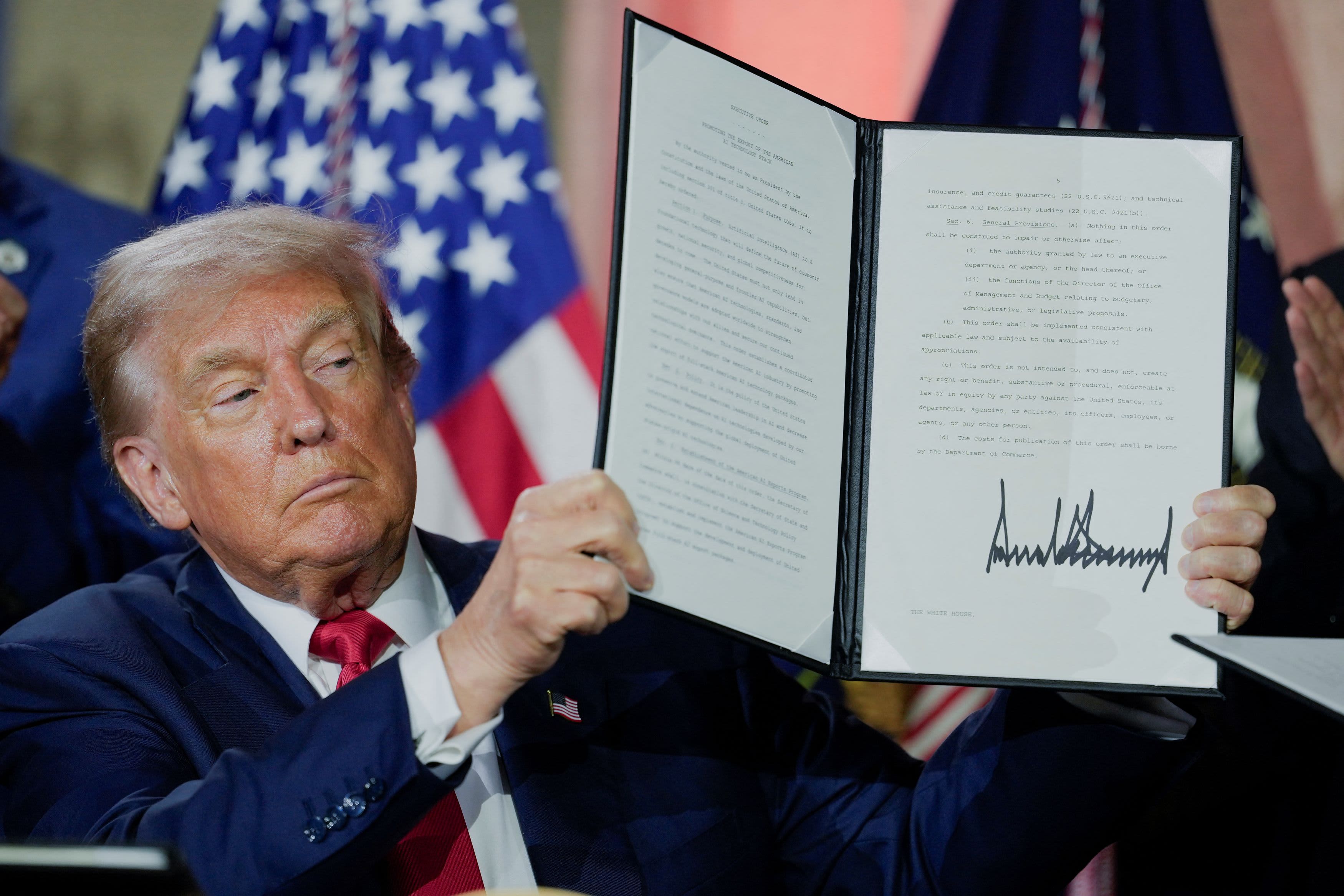
The Trump administration has taken a more hands-on approach to AI regulation since the president signed an AI executive order in June. The order asks AI developers to voluntarily provide models to the government to assess their capabilities ahead of a full release, and it gave federal agencies 60 days to develop an evaluation framework.
The process has been murky for companies that have tried to launch powerful new models in the interim.
OpenAI said in June that it agreed to limit the rollout of its GPT-5.6 model series to a group of "trusted partners" at the request of the U.S. government. Two weeks earlier, Anthropic had to disable access to its Fable 5 and Mythos 5 models to comply with an export control directive that was issued by the Commerce Department. Both companies later managed to release their models more broadly.
The Trump administration has taken steps to start implementing the executive order in recent weeks, namely by announcing a clearinghouse called "Gold Eagle." The clearinghouse aims to find and fix cyber vulnerabilities, and it puts the White House in charge of greenlighting which companies can access cutting-edge AI models, as CNBC previously reported .
The clearinghouse has already started to "intake and prioritize identified cybersecurity vulnerabilities" and "coordinate scanning verifications," according to a release from the White House. CAISI was not named as an agency involved with its development.
WATCH: Fmr. senior WH policy adviser on Trump admin lifting restrictions on Anthropic’s AI models
Got a confidential news tip? We want to hear from you.
Sign up for free newsletters and get more CNBC delivered to your inbox
Get this delivered to your inbox, and more info about our products and services.
© 2026 Versant Media…