
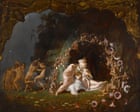
An uneasy adult fairyland … Richard Dadd, Titania Sleeping, 1841. Photograph: © GrandPalaisRmn (musée du Louvre) / Jean-Gilles Berizzi View image in fullscreen An uneasy adult fairyland … Richard Dadd, Titania Sleeping, 1841. Photograph: © GrandPalaisRmn (musée du Louvre) / Jean-Gilles Berizzi Art and design Review Richard Dadd review – can his mental illness help explain these arresting, bizarre images? Royal Academy, London Dadd was already a remarkable artist – with fairies as his hit theme – before he was locked up for murder. Yet it was within the confines of Bedlam that he saw nature and art afresh
Jonathan Jones Tue 21 Jul 2026 01.01 CEST Last modified on Tue 21 Jul 2026 01.02 CEST Share Prefer the Guardian on Google T he young man in the garden must be one of Richard Dadd’s fellow patients in Bedlam, you think. His unkempt hair and ruffled clothes are sure indications of a distracted mind as he sits, half his face in shadow, hands nervously clasped, on a fabulously twisted wooden bench surrounded by greenery that’s almost too lush for comfort. Yet the subject of Dadd’s 1853 Portrait of a Young Man is probably the superintendent of Bethlem Hospital, Dr Charles Hood. The painter sees reflections of his own mental state in this frail-seeming young clinician. Patient and doctor are not so different, he suggests. There is the finest of lines between “sanity” and “madness”.
Dadd crossed that line when he murdered his father whom he thought was the devil, then tried to kill a stranger while fleeing to Paris. He was quickly caught and would spend the rest of his life in Bedlam and Broadmoor. But how much does his mental illness explain his arresting, bizarre, sometimes unforgettable images? Is he a kind of Victorian acid casualty whose visions of fairies are the peculiar fruit of his psychosis?
View image in fullscreen Richard Dadd, Portrait of a Young Man, 1853. Photograph: Sonal Bakrania/© Tate / Tate Images The Royal Academy’s smallish Dadd survey is called Beyond Bedlam and urges us to see him as more than just a “mad” artist. Yes, he spent more than 40 years in psychiatric hospitals where he was judged incurable and where he painted his masterpiece The Fairy Feller’s Master-Stroke, that monstrously magnified corner of an English country garden. But he was already a remarkable artist, with fairies as his hit theme.
These are not cute Disneyfied fairies but the original mysterious beings from British folklore, sinister and destructive, as portrayed by Shakespeare. Dadd’s early painting of Puck has the mischievous sprite personified as a giant baby irradiated by lunar light. In Titania Sleeping , we glimpse, through a parted curtain of bats, nude female fairies. It’s an uneasy adult fairyland. So too is The Haunt of the Fairies in which a female fairy – or is it just a naked woman? – gazes at us against trees silhouetted in the red twilight of a very British landscape.
Then Dadd went on an epic trip to the Middle East, filling his sketchbook with mosques, markets, Egyptian ruins, but what should have been a stimulating escape tipped him into severe paranoia and murder. This was when a promising life cracked open.
When the fairies return to him in Bedlam they are brutally different. His early work is imaginative but visibly influenced by Romantic artists like Fuseli and Runge . But there’s no precedent that helps to understand The Fairy Feller’s Master-Stroke. Painted over a nine-year period, it disobeys the pictorial rules in wh…