
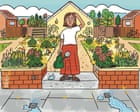
Gardeners bear the brunt of the ban – but are they really to blame? Illustration: Sean O'Brien/The Guardian View image in fullscreen Gardeners bear the brunt of the ban – but are they really to blame? Illustration: Sean O'Brien/The Guardian Water ‘People are scared their neighbours will call the police on them’: how the hosepipe ban got caught up in the culture wars While many people in the UK recognise the need to preserve water, others are furious and planning to flout the ban in their area. The target of their anger? Failing water companies and frighteningly thirsty data centres
Sammy Gecsoyler Thu 23 Jul 2026 06.00 CEST Last modified on Thu 23 Jul 2026 06.06 CEST Share Prefer the Guardian on Google ‘P lants are like your babies,” says Harry. And accordingly, he argues, most people would do anything to keep them alive, including break the law. This is what he plans to do this week – defying a hosepipe ban in place across large parts of England, to ensure his shrubs maintain a steady pulse.
He may not be alone. On Tuesday, Thames Water became the latest company to ban hosepipes – a restriction that will affect more than 10 million people. Since mid-July, Welsh Water, Anglian Water, Affinity Water (serving Bedfordshire, Berkshire, Buckinghamshire, Hertfordshire and Surrey), Southern Water and Cambridge Water have all announced hosepipe bans. And earlier this week, South East Water extended its existing ban to cover an additional 1.5 million.
Harry, 24, has spoken to friends and family in his leafy corner of Essex who are equally fed up with the ban that has been in place on and off since the beginning of July. “Unless they turn the taps off, I’m still going to use it,” he says. “It’s another thing that makes people say they want to leave the UK, these silly little rules.”
Others are using the ban to stoke up division. Suella Braverman MP says it’s yet another “act of lunacy in Labour’s two-tier Britain”. The Reform UK politician was responding to a Telegraph front page declaring that benefit claimants are exempt from the hosepipe ban. The Conservative party chair, Kevin Hollinrake, also chimed in, calling it a “kick in the hosepipe”.
Despite the furore the exemption has caused, the truth is that it does not apply to all those who claim benefits: households that qualify to be on a water company’s priority services register would need to be benefits claimants who have either three or more children, or someone with a medical condition that requires the use of significant amounts of water – dialysis, for example. Disabled people and blue badge holders are also exempt.
Regardless of this much more nuanced reality, the hosepipe ban has become the subject of a new culture war, an attempt to pit the haves (in this scenario, poor and disabled people, who are allowed more water) against the have-nots (able-bodied people with an earned income).
View image in fullscreen St James’s park in London earlier this week. Photograph: Amer Ghazzal/Shutterstock Why has the ban been put in place, anyway? The answer, as with so many things, is the climate crisis. In 2025, the UK recorded its hottest year ever . According to the Met Office, 2026 is already showing hotter and drier conditions than last year – with three heatwaves to date. Daniel Johns, the managing director at the non-profit Water Resources East, says river levels have reached “all-time lows”. In May, a House of Lords report said England faces a 5bn-litre-a-day water shortfall…