
Science Why Thousands Of Eclipse Chasers May Soon Miss Totality In Spain By Jamie Carter ,
Forbes contributors publish independent expert analyses and insights. An award-winning reporter writing about stargazing and the night sky. Follow Author Jul 23, 2026, 02:00am EDT Topline Thousands of eclipse chasers are expected to travel to northern Spain for the total solar eclipse on Aug. 12, but many could leave disappointed if they fail to understand one crucial detail — it happens close to sunset. While the path of totality crosses northern Spain, the event will occur so late in the day that totality could easily be obscured by mountains, trees and buildings. Fortunately, a growing number of websites, apps and planning tools can help eclipse chasers and locals plan where to observe in advance of the rare celestial event.
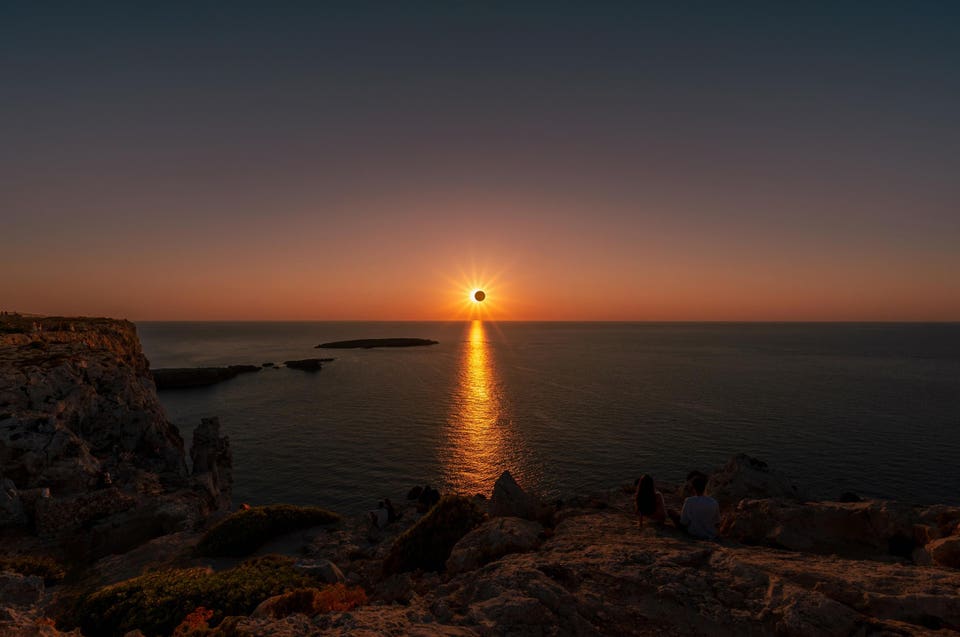
A simulation of the geometry of the total solar eclipse on Aug. 12, 2026, as seen from the west-facing coast of Menorca, Spain. Eclipse chasers in the path in Spain could find their view blocked by mountains, buildings and trees. getty Key Facts A total solar eclipse will occur on Wednesday, Aug,. 12, with the 190 miles (305 km) wide path of totality — a projection of the moon’s dark shadow — moving across eastern Greenland, western Iceland and northern Spain.
Totality — when daylight briefly fades and the sun’s spectacular corona becomes visible to the naked eye — will last up to 2 minutes 18 seconds, depending on the observer’s location within that path. Outside the path, just a partial eclipse will be visible and solar eclipse glasses will need to be worn.
When totality reaches Galicia in northwest Spain, the totally eclipsed sun will be just 11 degrees above the northwest. By the time it reaches Valencia on the east coast of Spain, it will be a mere 4 degrees above the horizon.
Most at risk are eclipse observers in the Balearic Islands — Mallorca (Majorca), Menorca, Ibiza and Formentera — where totality will take place with the sun and moon just a few degrees above the north-western horizon.
Eclipse glasses are required to safely look directly at the sun except during the brief total phase of a solar eclipse (“totality”), when the moon entirely blocks the sun’s bright face. That will happen only within the narrow path of totality.
A map showing the partial solar eclipse zone across North America on Wednesday, Aug. 12, 2026. Michael Zeiler/EclipseAtlas.com Why Sunset Matters For Eclipse Viewing All total solar eclipses start with a totally eclipsed sunrise and end with a totally eclipsed sunset, but it’s the norm for both extremes to occur in remote areas, or at sea. On Aug. 12, the path of totality begins in remote Siberia and ends in the Balearic Islands, but across Spain, the total eclipse will occur low in the sky. The risk is that observers farther east may see only a deep partial eclipse before the sun and moon disappear below mountains, buildings and trees on the northwest horizon. For eclipse chasers hoping to witness the dramatic moments of totality, location will therefore be everything, with high ground, coastal viewpoints and elevated landscapes likely the best options. What many observers will underestimate is the importance of geometry; totality will be in the northwest, making the Mediterranean coast, where many resorts are, a poor choice.
Experts advise arriving early, scouting viewing locations in advance, and monitoring updated weather forecasts as the event approaches. Since the eclipse will oc…