
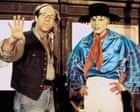
Chuck Russell, left, with Jim Carrey on the set of The Mask, 1994. Photograph: New Line Productions/Album/Alamy View image in fullscreen Chuck Russell, left, with Jim Carrey on the set of The Mask, 1994. Photograph: New Line Productions/Album/Alamy Film Obituary Chuck Russell obituary Film-maker who reshaped The Mask as an exuberant comic spectacular and launched the film careers of Cameron Diaz and the Rock
Prefer the Guardian on Google The film-maker Chuck Russell, who has died aged 74, described himself as “a thrill junkie with a sense of humour”. The proof was in the pudding: his madcap comedy The Mask (1994) resembled a cinematic knickerbocker glory overflowing with colour, vitality and fun. Its star Jim Carrey called it “one of the jewels of my creative life”.
Before Russell was attached to the project, The Mask had been doing the rounds in Hollywood for several years as a horror script. Once he came on board, he persuaded the studio New Line Cinema to let him reshape it as an exuberant comic spectacular. “I wanted to take the various things I know about special effects and apply it to dance and comedy,” he said.
The film’s Jekyll-and-Hyde-style story is simplicity itself: when he dons an ancient wooden mask, a timid bank clerk (Carrey) is transformed into an anarchic, lime-faced jester in a banana-yellow zoot suit. Russell created a riotous live-action cartoon that fused Carrey’s gift for physical mayhem with cutting-edge CGI. “I found myself leaning towards Tex Avery physics,” Russell said; he showed a thumping heart protruding from the actor’s chest, eyeballs flying from their sockets and an elongated tongue unspooling like a red carpet.
Between them, he and Carrey developed what the director called a “windup-and-pitch” style of shorthand on set. “I would tell Jim I needed a bigger windup, and he knew he had to cock his head back to give me a greater forward thrust because I was going to extend his entire face five feet by the time I was done with it.”
View image in fullscreen Russell on location with Grant Heslov and Dwayne Johnson (the Rock, right) for The Scorpion King, 2002. Photograph: Cinematic/Alamy Russell called Carrey “an uncanny talent … The problem was night shooting, when Jim would crash after ‘lunch’ at 2am. We played a little game to keep him going during the long wait for lighting on those nights. I’d toss out a double impression challenge; not just a celebrity impression, but [something like] ‘Elvis doing Clint Eastwood’… This kept us alert and laughing in the wee hours.”
Raking in more than $351m, The Mask became the fourth highest-grossing release of its year. “I designed the film to play internationally,” Russell said. “There is something universal in the … fear of letting loose. The release of all these fears and dreams could be a good thing, it could be a bad thing. You just don’t know. However, it is a dangerous thing. That is a wonderful, universal idea.”
It did not hurt that he insisted on pairing Carrey with the charismatic newcomer Cameron Diaz. “It became quite a campaign for me to get the studio to accept using a totally inexperienced actress in a lead role.” He described the chemistry between the leads as “the real ‘special effect’” in The Mask.
Launching new acting talent was a speciality of his. He made his directing debut with the horror sequel A Nightmare on Elm Street 3: Dream Warriors (1987), which also marked Patricia Arquette’s movie debut. On the Arnold Schwarzenegger action vehicl…