
By Esports Legal News 28 July 2026 5 min read
A team wins the final round, yet the result appears in chat before the decisive play reaches the video. A score notification may arrive first, followed by a statistics page, then the commentator’s call several seconds later. None of those screens has to be wrong. A live esports broadcast is a chain of systems, and each system handles the match on its own clock. The useful question is therefore not simply, “How delayed is the stream?” It is, “Which stage am I watching, and how far is it from the game server?”
Research on live adaptive video streaming describes a process involving encoding, segmented delivery, network conditions, and playback buffers. Each stage can add time. Reducing one source of latency may also create another trade-off, such as less protection against interruption or a lower-quality picture when the connection becomes unstable. That is why a single universal delay figure is rarely useful. The same tournament can reach viewers differently depending on the production setup, distribution path, device, connection, and player settings.
The clearest way to understand esports stream delay is to separate server time, production time, and viewer time. The server records the competitive action first. The production feed then selects observer angles, graphics, commentary, and replays. The viewer receives an encoded version after it has crossed a delivery network and entered a local playback buffer.
This is also important to remember when you’re looking at other sources online; they may not all update on exactly the same timeframe. Lucky Rebel is a sportsbook visited by many while watching esports matches, as it provides odds and betting opportunities. Many viewers will check in with it during a live match, and might be puzzled when they see odds shift or a market update unexpectedly, even though they can’t instantly see a reason on their own feed. Bearing in mind that there can be a delay on the feed, or on the odds updating, is particularly key if you’re betting; you should ensure that you are using the most up-to-date information at all times.
It’s important to remember that the broadcast itself can also sit behind the server because the observer feed must be produced, encoded, packaged, distributed, and buffered before it appears on a viewer’s device. A visitor to Lucky Rebel can inspect what is visibly presented there, but the page does not replace title-specific knowledge about tournament production, match servers, or a particular stream’s delay. Their clocks may overlap, but they are not automatically synchronized.
A companion article about live betting in real time shows how viewers are often encouraged to combine what they see with changing information during play – admittedly through traditional sports, without the additional challenges of latency or buffering problems. It’s still useful because it reminds users about the importance of momentum and in-game data for betting. The setting may be different, but the insights translate.
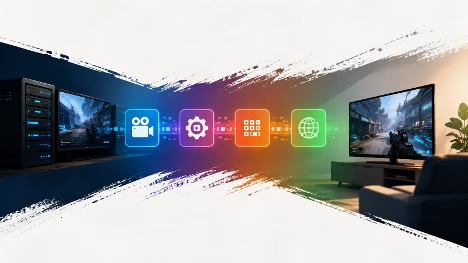
The path from match to screen can be read as six connected stages. First, the match server records player actions and confirms the game state. Second, an observer client turns that state into a watchable feed. Third, the production team adds camera choices, overlays, commentary, and replays. Fourth, the video is encoded and divided into deliverable segments. Fifth, a content-delivery network moves those segments toward the viewer. Sixth, the…