
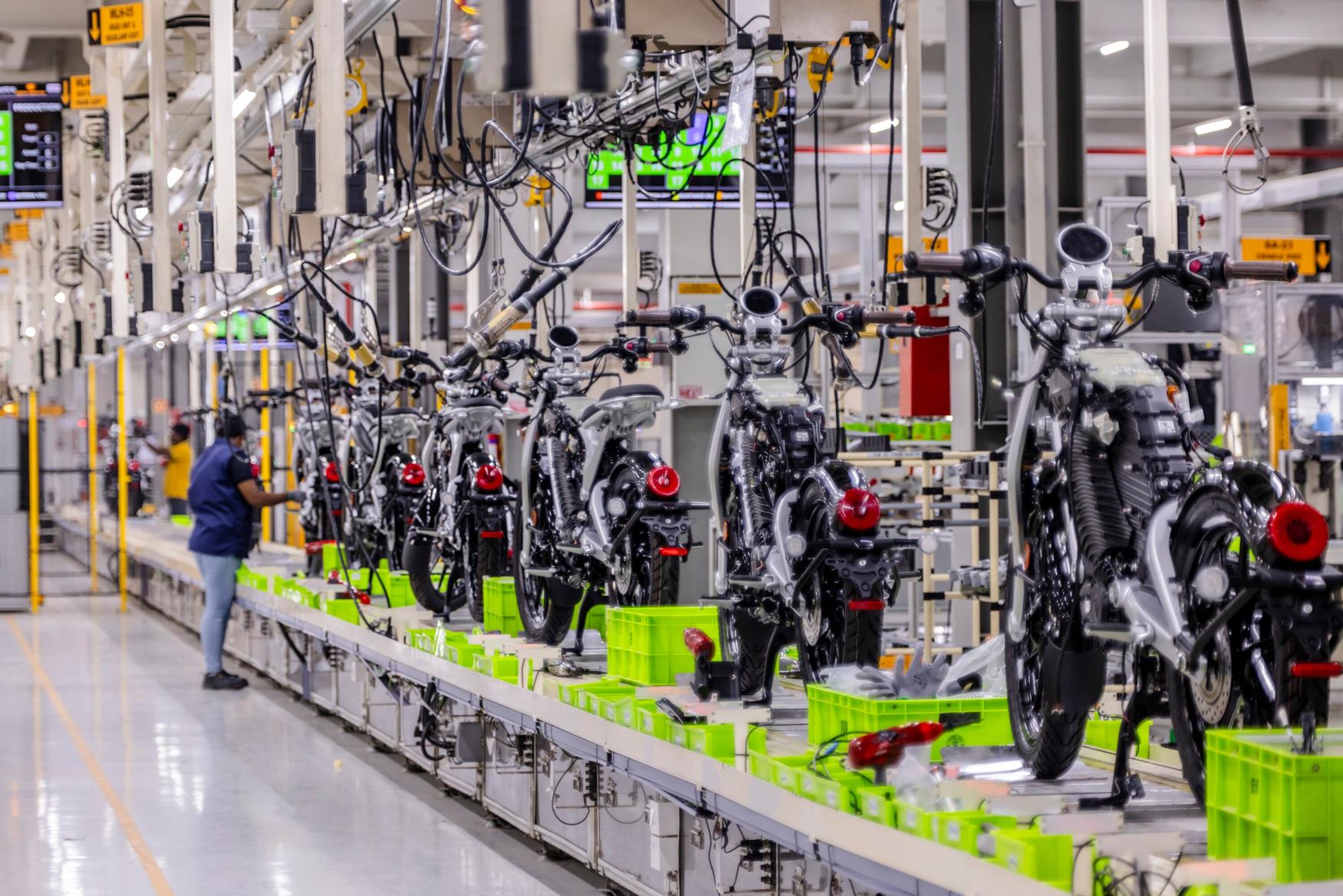
With news that Royal Enfield ’s long-awaited Flying Flea C6 electric bike is finally coming to our shores, MCN got an exclusive look inside the brand’s Tiruvottiyur factory in Chennai which is home to their new, state‑of‑the‑art EV lab.
“This lab was built in almost one year,” said Chief Technical Officer, Umesh Krishnappa. “We spent around US$7million [£5.26million] and it’s ready to take us to 2033 – this has been built with a vision.”
The facility is where all systems such as battery, and powertrain are tested for the Flying Flea, with experts from both the motorcycle and electrical industries brought in to aid development.
“Reliability is the ability of the vehicle to perform consistently over a period of time,” said Krishnappa. “You call it mechanical durability, but for electrical components we talk of reliability. Before we launched the vehicle, we measured the reliability of each subsystem, for 100,000km or 10 years.”
The first part of the lab was established to research and test the battery, with the original concept bike seen at the EICMA trade show in Milan in late 2024.
“When we started in June 2024, we had to build batteries in-house because we were designing it,” said Krishnappa. “This is the first battery lab – at least in the Indian two-wheeler industry – which has a laser welding system. We have to weld the bus bars [a conductive metal strip] so that all 224 cells are connected.”
Using laser welds rather than traditional welds means no heat energy is transferred to any of the cells in the battery – as a result, their health remains optimal. All the cells are aligned on a jig then encased in a magnesium casing, a first for Royal Enfield.
Krishnappa explained the initial process takes a lot of cooling to prevent structural issues, but the benefits are a lightweight case and better heat transfer to avoid overheating in the battery.
The cells are produced elsewhere, but a sample is always checked using a US$1.2million [£900,000] CT scanner – undergoing testing at different temperatures for 2000 cycles or about 60,000km.
“We use chambers with international certification. They are very safe – even if the battery pack explodes during testing they will be safe,” Krishnappa added. “They are very expensive but allow cells to be tested at different temperatures.”
The cells are sorted into three categories based on their impedance rating (resistance to electrical current) then collated to ensure they are “harmonic within 20 millivolts”.
“Ultimately in EVs, safety has priority, even if it derates the current for some time and reduces the speed,” Krishnappa said. “That electronic system is known as the battery management system.”
Other safety measurements include a high‑rate discharge test and a leakage test to ensure water and dust ingress isn’t possible.
“We have a small unit called the Vehicle Control Unit [VCU] which is the master of the vehicle – it’s the central command,” he added. “There are hundreds and thousands of signals happening at any one point in time. For us, we prioritise safety and then connection. But this is a hardware that is CE certified for cybersecurity.”
The VCU is designed by Enfield but not currently manufactured in-house; plans are in place to bring the process into the factory.
But it’s not all about hardware. With the C6 set to be a global motorcycle, the lab has a dedicated space to test software and ensure connectivity works worldwide.
“We have a facility in which none of the other OEMs…