
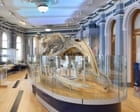
She sounds! … the skeleton of a 40ft-long North Atlantic right whale dominates Hull Maritime Museum’s Age of Sail gallery. Photograph: ©Hufton+Crow View image in fullscreen She sounds! … the skeleton of a 40ft-long North Atlantic right whale dominates Hull Maritime Museum’s Age of Sail gallery. Photograph: ©Hufton+Crow Architecture Thar she blows! Hull Maritime Museum resurfaces with a walk-in whale and a ‘monkey mermaid’ The £20m reboot shows off exhibits ranging from a giant whale skeleton to tiny ‘scrimshaws’ of carved bone to a very strange mermaid, all telling a gripping tale of a great seafaring city
Prefer the Guardian on Google T he star attraction of Hull’s revamped and revitalised Maritime Museum is a colossal 40ft-long skeleton of an North Atlantic right whale, beached more than a century ago. The remains of this leviathan dominate an exhibition space scarcely large enough to contain its stupendous bulk. Children can crawl into its ribcage, like junior Jonahs, popping up in a clear plastic dome as digital images of swimming whales slowly unspool across the ceiling.
Docile, leisurely and extremely blubbery – which meant that harpooned carcasses conveniently floated, as well as yielding copious quantities of valuable oil – the North Atlantic right whale was hunted almost to extinction during the whaling era. Today, it’s estimated that there are fewer than 400 left.
View image in fullscreen Exhibits ahoy … exterior of the revamped Hull Maritime Museum. Photograph: ©Hufton+Crow At the other end of the cetacean scale is a delicately carved whale that can fit into the palm of your hand, studded with miniature harpoons designed for use as toothpicks. It forms part of the museum’s world class collection of scrimshaw, the niche and intensely fiddly folk art of carving and decorating pieces of ivory or bone. Crewmen would while away the long hours “scrimshandering”, inscribing whales’ teeth and walrus tusks with images of ships and patriotic Britannias, or tableaux from their travels and portraits of loved ones. Other bounties on display include the spiralled rapiers of narwhal tusks, surreally fashioned into hatstands and bedposts.
Hull’s geography ensured that its history was indisputably maritime. Set at the confluence of the River Hull and Humber estuary, it prospered, successively, through trading, whaling and fishing. Latterly, its historic relationship with the sea has been renewed through the production of wind turbine blades for offshore arrays at the city’s Alexandra Dock. And Hull and the Humber remain one of the UK’s busiest port complexes.
View image in fullscreen Scrimshandered … sperm whale tooth engraving of the Phoenix of London by Burdett Phoenix, 1820s. Photograph: © Hull Maritime Museum Nonetheless, the sense of city out on a limb, and one that has seen better days, still persists. Hull’s centre is pockmarked with vacant shops, and its docklands, which took a pounding during the second world war, remain apologetically gap-toothed in places, despite the crowded marina and upscale warehouse conversions.
The poet Philip Larkin, Hull’s most infamous adopted son, who measured out his life in coffee spoons as head librarian of the city’s university, wrote of “the surprise of a large town … where only salesmen and relations come, within a terminate and fishy-smelling pastoral of ships up streets ...” Larkin had an ambivalent relationship with Hull, but a statue of him, erected in 2010, now greets you at the city’s Pa…