
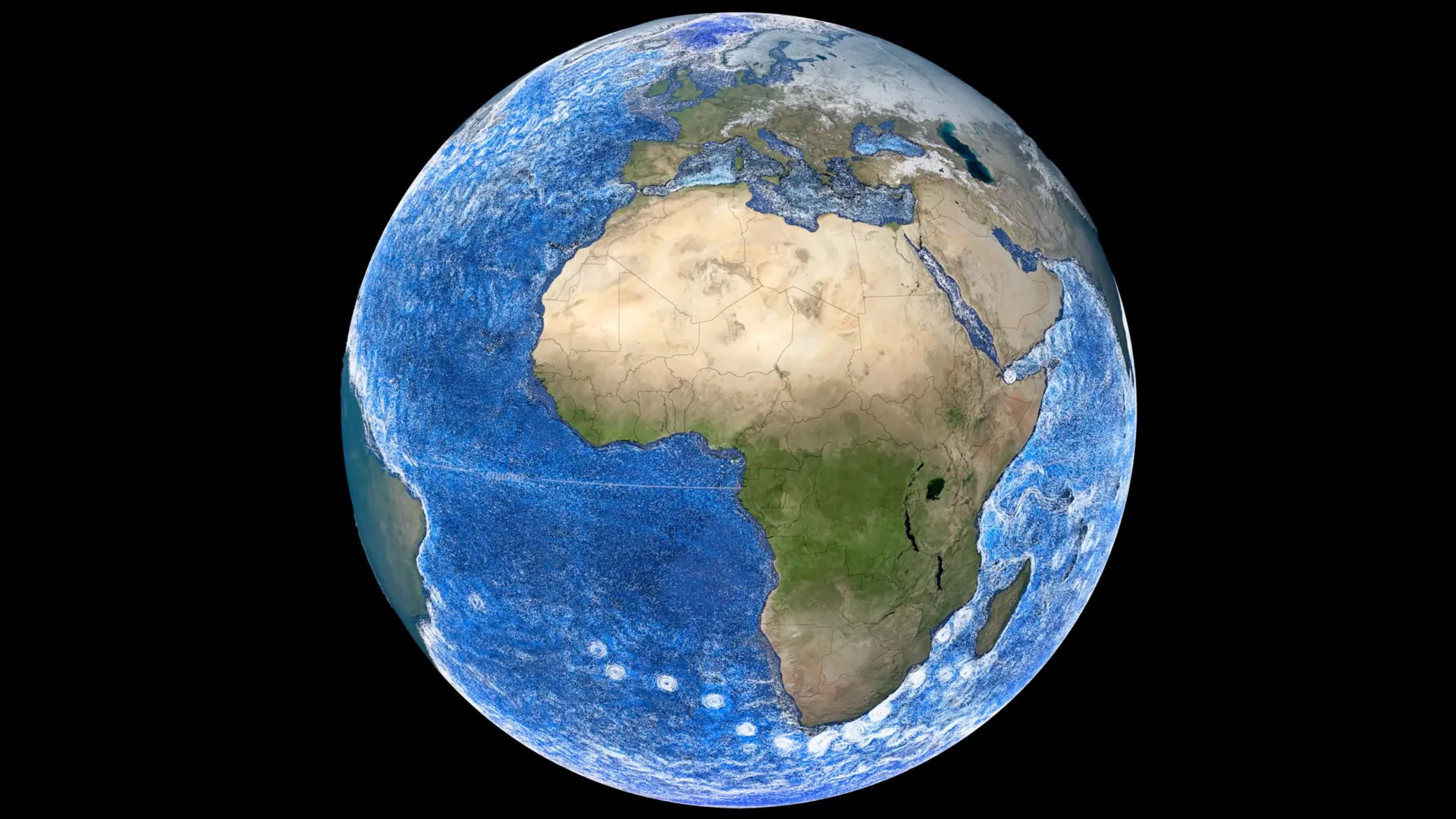
Scientists have long believed that warm, salty water flowing from the Indian Ocean around the southern tip of Africa and into the Atlantic helps support one of the planet's most important ocean circulation systems. This flow, known as Agulhas Leakage, has been considered a major contributor to the Atlantic Meridional Overturning Circulation (AMOC), which forms part of the global ocean conveyor system.
New findings from an international research team based in the Netherlands, USA, China and UK suggest that this relationship is more complicated than previously assumed. Their results indicate that changes in Agulhas Leakage do not always produce the expected response in deep water formation. The study offers a clearer picture of how the AMOC works and how its behavior may vary under different climate conditions.
Testing a Textbook Explanation of the AMOC
The Atlantic Meridional Overturning Circulation (AMOC) transports warm surface water toward the north while carrying colder, denser water back toward the south at greater depths. Through this exchange, it influences temperatures across the North Atlantic and much of Europe, making it a central part of the global climate system.
For decades, researchers have proposed that Agulhas Leakage helps maintain or strengthen the AMOC. This leakage carries warm, salty Indian Ocean water around South Africa and into the Atlantic. Its strength is influenced by shifts in the position of the subtropical front. According to the traditional explanation, the added salt encourages the formation of North Atlantic Deep Water, which helps sustain Atlantic overturning.
"This was basically the first textbook concept, that I learnt when I was a bachelor student. It was surprising to find geological evidence showing that it isn't universally true. The AMOC can remain strong even when Agulhas Leakage weakens," explains lead author Dr. Suning Hou from Utrecht University.
Hou and his colleagues examined conditions during the late Pliocene (3.6-2.6 million years ago). This period included a short but significant glacial event followed by the mid-Piacenzian Warm Period, when global conditions were warmer than they are today. The transition provided researchers with a useful opportunity to study how ocean circulation near South Africa and within the Atlantic responded as the climate shifted from cooler to warmer conditions.
Ancient Sediments Reveal Shifting Ocean Boundaries
The team studied a marine sediment core collected from International Ocean Discovery Program Site U1475 on the Agulhas Plateau, about 500 kilometers south of South Africa.
Within the core, researchers examined fossilized microplankton known as dinocysts, along with organic lipid biomarkers. These materials allowed them to estimate past ocean temperatures and track movements of the Southern Ocean subtropical front toward the north or south.
Hou: "If you find a change in the dinocyst assemblage in the sediment, this means that the front shifted. For instance, if you find more of the warmer species and less of the colder ones, the front has moved south. A more southerly front generally opens a wider pathway for Indian Ocean water to leak into the Atlantic, and vice versa."
Using these indicators, the researchers produced a detailed reconstruction of possible changes in Agulhas Leakage throughout the late Pliocene.
To determine how the Atlantic responded, they also developed temperature records from Ocean Drilling Program Site 625 in the north…