
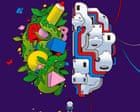
Illustration by Mojo Wang Books ‘I hate what AI is doing to the minds and happiness of the young’: Katherine Rundell on the view from the classroom Education is at a crossroads, argues the author and academic. Should we embrace new technology in the name of efficiency, or is it time to fight back?
If you set out to design from scratch a tool to facilitate authoritarian rule, it would look exactly like AI. You would cherish it for its ability to destabilise our shared reality and its creation of disinformation on a scale unprecedented in human history. With it you need no armies of typists and artists to spread your propaganda. It can enable mass surveillance and thereby put shackles on those who seek to resist you. Its lethal autonomous weapons systems can perfect and normalise remote killing. It will turbocharge inequality; it is already facilitating a breathtaking shift of power and wealth from the hands of the many to the hands of a tiny number of men who – to put it in terms for which I can’t be sued – seem to hold dangerously damaged views about the value and dignity of human life.
AI could be a magnificent thing. It could revolutionise medicine, speed the cure of cancer, assist disabled people, transform the way we are able to understand data, democratise access to the law, bolster disaster early warning systems and uncover hitherto unimagined truths about the Earth’s ecosystems. But if it ends up in the hands of crooks and despots that will be completely irrelevant.
Most of all, if you were a would-be autocrat, you would love the way that large language models (LLMs) such as ChatGPT, Claude and Google’s Gemini have thrown a grenade into thousands of years of teaching and learning: the way they threaten to upend our ability to think with the robust clarity that is needed in emergencies of justice. I write fiction for children and I hold a fellowship at Oxford University, so I spend a lot of time working with, and for, young people. I’ve seen first-hand the way that generative AI has already infiltrated young people’s lives. I’ve seen, at the same time, how it has thrown stark and urgent light on how fundamental books and reading are to our shared understanding of who we are, and to our democracy.
There are many things I hate unequivocally about AI. I hate that it can make counterfeit people; computer-generated humans that risk destabilising our entire civilisation. I hate that much of AI’s LLMs were built on an illegal pillage of human labour. I hate the environmental catastrophe that AI brings with it: the yearly electrical demand of AI-optimised data centres is predicted, by the end of this decade, to exceed that of the whole of Japan. I hate that it may be the factor that tips the Earth’s ecosystems into irreparable chaos.
And I hate what it is doing to the minds, and the happiness, of the young. Going into schools, I meet thousands of children a year and every day I become more certain that, if justice for all is to be our organising principle, AI is not for children and not for young people. It risks becoming an iron curtain that comes down between a young person and their potential for thinking, for experiment and conquering frustration, for stamina and for invention – and thereby, between the young people and their freedom. It risks halting learning before it can take flight.
AI, we’re told, will make learning more efficient. But is that what we dream of for our kids – an efficient childhood? Studies show, over and ov…