
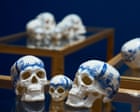
English Family China, 1998, by Christine Borland, on display at Turner: Always Contemporary, Walker Art Gallery, Liverpool, 2025. Photograph: Christopher Thomond/The Guardian View image in fullscreen English Family China, 1998, by Christine Borland, on display at Turner: Always Contemporary, Walker Art Gallery, Liverpool, 2025. Photograph: Christopher Thomond/The Guardian Art Obituary Christine Borland obituary Turner prize nominee whose installations, sculptures and films returned repeatedly to the histories embedded within bodies
Prefer the Guardian on Google In 1994, Christine Borland, who has died aged 61 of cancer, opened her first solo exhibition at Tramway in Glasgow. Its starting point was a mail-order catalogue through which human skeletons could be legally purchased for medical teaching.
The discovery that a person’s remains could be bought anonymously through the post gave rise to one of the defining questions of her career. Working with forensic experts, police and medical professionals, Borland attempted to reconstruct the life behind one such skeleton, producing a bronze facial reconstruction alongside the original bones.
View image in fullscreen Christine Borland. Photograph: Jeremy Sutton Hibbert/Shutterstock The work, From Life , did not solve a mystery so much as expose one, asking how identity is lost, who is remembered and what obligations remain towards the dead. When it was nominated for the Turner prize in 1997, Borland was recognised as one of the most original voices in British contemporary art.
She occupied a singular place within the generation that transformed British art during the 1990s. While many of the Young British Artists became associated with provocation, spectacle or autobiography, she pursued another path altogether.
Her work emerged through sustained collaborations with technical experts – including museum curators and archivists – treating science not as subject matter but as a partner in artistic inquiry. Long before interdisciplinary practice became commonplace, she demonstrated how artists could work alongside researchers to explore questions that neither discipline could answer alone.
Her installations, sculptures and films returned repeatedly to the histories embedded within bodies, specimens and collections. Rather than celebrating scientific certainty, they revealed the ambiguities, ethical responsibilities and acts of interpretation that underpin medical knowledge itself.
Among her most affecting works was Phantom Twins (1997), inspired by 19th-century obstetric teaching models used to train midwives. Borland recreated these instructional objects as leather dolls containing foetal skeletons, transforming instruments of medical education into sculptures that were at once memorials, anatomical studies and reflections on care, loss and the body’s vulnerability.
View image in fullscreen Borland’s artwork The Edinburgh Seven Tapestry, celebrating the seven Edinburgh University students who were the first women to study medicine, on display at the Victoria & Albert Museum, London, 2024. Photograph: Guy Bell/Rex/Shutterstock In The Dead Teach the Living (1997), she questioned the supposed objectivity of forensic reconstruction by exposing the assumptions that shape representations of race and identity. L’Homme Double (1997) invited six sculptors to reconstruct the face of the notorious Nazi medical experimenter Josef Mengele from identical forensic evidence. Each produced a different lik…