
on Google Preferred Source Google News Link copied to clipboard By Aimee Hart Published Aug 10, 2026, 5:00 PM EDT House of the Dragon Rhaenyra the Cruel finally arrives, but will it pay off?
Image: HBO/Ollie Upton Whether you love or hate it, you can’t deny that showrunner Ryan Condal and writer Sara Hess’s adaptation of George R.R. Martin ’s Targaryen history book, Fire & Blood , has been entertaining from start to finish. The House of the Dragon season 3 finale proved to be no exception, even if it also introduced a number of changes to the original story.
For the most part, these changes from Condal and Hess have been for the best. Making Alicent and Rhaenyra around the same age, for example, has proven to be a far more interesting move than going down the evil crone stepmother versus young stepdaughter route. However, the latest changes in the House of the Dragon season 3 finale have us questioning just how far the show's planned fourth and final season may deviate from the original ending for a certain character in Fire & Blood .
Warning: This article contains spoilers for House of the Dragon’s season 3 finale and the ending of The Dance of Dragons segment in Fire & Blood .
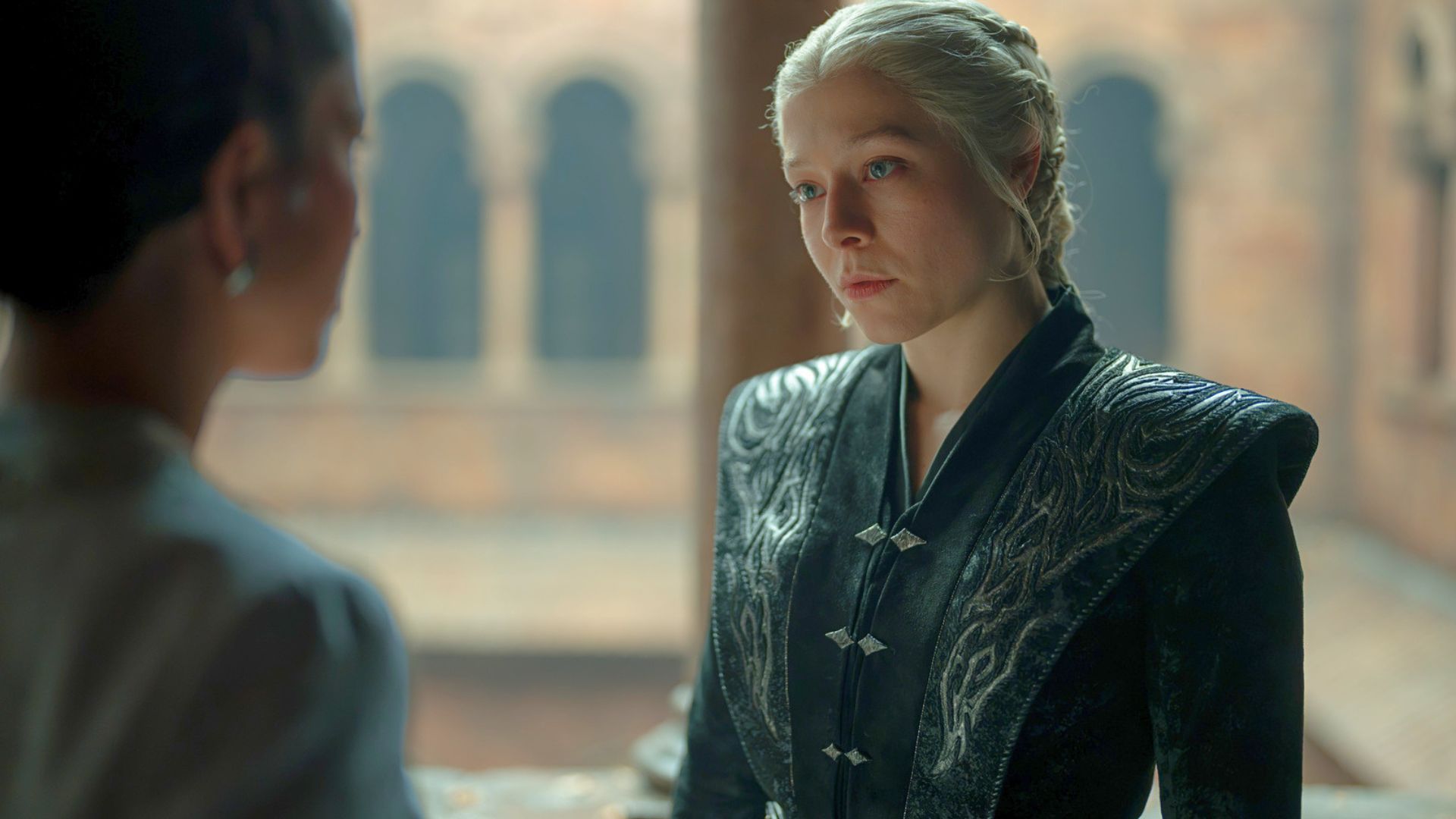
After three seasons of trying to prove herself capable of ruling, both to the people of Westeros and to her own allies, Rhaenyra Targaryen (Emma D’Arcy) has officially hit the point of no return. The two people who have the power to keep her moral conscience in line, Alicent Hightower (Olivia Cooke) and Mysaria (Sonoya Mizuno), have both been sent away. This leaves Rhaenyra with only Daemon Targaryen (Matt Smith), who, while certainly the Black Queen’s biggest supporter, has godlike ambitions and cares little for anyone and anything outside of Targaryen exceptionalism.
It’s no wonder then that after losing her sons, and with the ongoing panic at the realization that her biggest threat, Aegon Targaryen (Tom Glynn-Carney) and his dragon Sunfyre are still alive, Rhaenyra isn't afraid to sacrifice anyone and everything to ensure her future as ruler of Westeros. This is especially felt in her treatment of her half-sister, Helaena Targaryen, whom she force-fed gruel and then, quite literally, shut the window on, after uncovering her sister’s death at the end of the episode.
Image: HBO/Ollie Upton However, a major change in season 3’s finale suggests things are only going to get worse for Rhaenyra. In Fire & Blood , Rhaenyra’s short reign of King’s Landing is so horrific in the eyes of the smallfolk that she is given the rather crude nickname of “Maegor with Teats” — referring to a previous mad Targaryen ruler, Maegor the Cruel. She also becomes known as “Rhaenyra the Cruel.” While these nicknames do originally stem from the heavy taxation the Master of Coin puts on the smallfolk of King’s Landing to help with the war effort, the name sticks to Rhaenyra after the people learn about Helaena’s suicide and immediately assume Rhaenyra had something to do with it, as well as her increasing paranoia and distrust of those close to her. This eventually leads to Rhaenyra having so few allies that it’s easy for Aegon to capture her and her forces on Dragonstone.
The paranoia, however, is understandable in the book. In Fire & Blood , Rhaenyra loses the Battle of Tumbleton when her dragonriders, Ulf the White (Tom Bennett) and Hugh Hammer (Kieran Bew), betray her army and supporters, bathing them in dragonfire. Any betrayal is terrible, but two of her best dragons? It’s a b…