
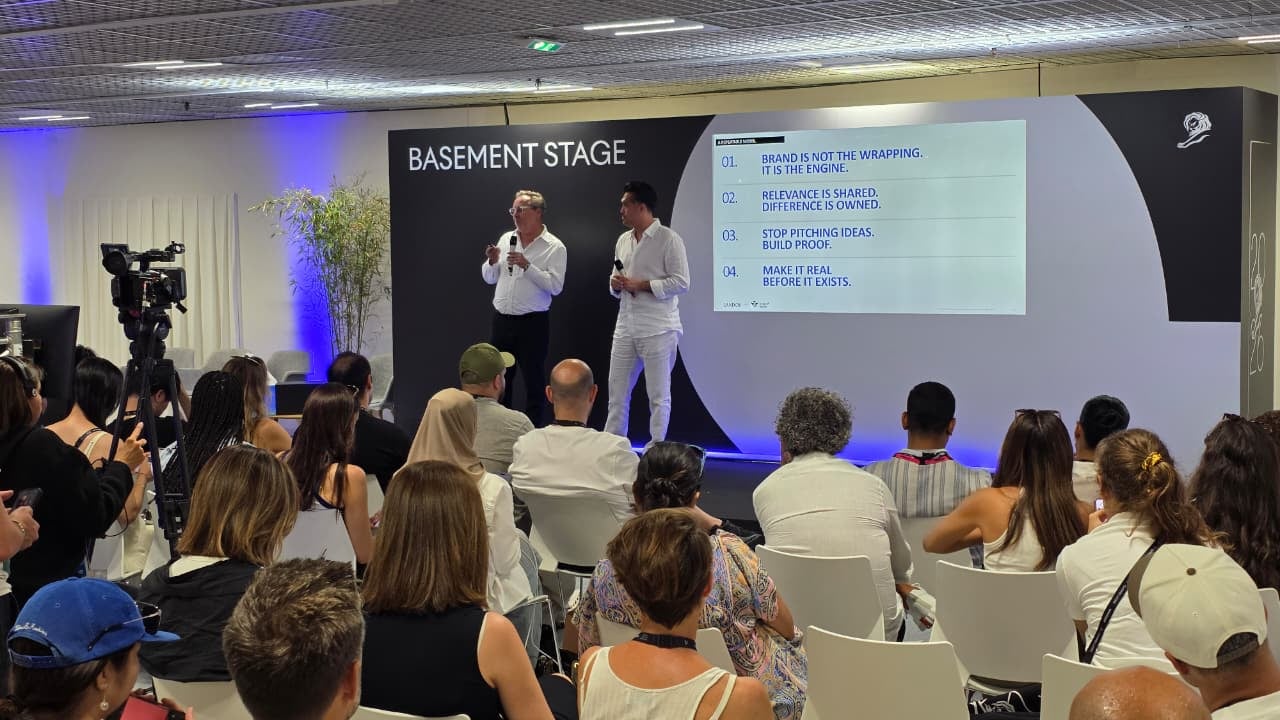
As brands across the region look to move beyond campaigns and into meaningful innovation, the challenge is no longer a lack of ideas. It is knowing which ideas are worth backing and having the confidence to see them through.
At Cannes Lions 2026 , Campaign Middle East spoke to Luc Speisser, Global Chief Strategy and Innovation Officer at Landor, and Essam Akhonbay, VP Marketing at Saudia Airlines, about the thinking behind The Coolest Ihram, a high-tech cooling garment developed to support pilgrims during Hajj.
The conversation explored a broader question facing brands investing in innovation: why do so many ideas fail to make it from concept to market, and what can organisations do to reduce that risk?
For Speisser, one reason is that innovation has traditionally been built around solving a customer problem, without necessarily considering what makes an idea distinctive to the brand behind it. “Because the industry has been solving the wrong problem. The frameworks that are used – design thinking, Jobs to be Done, lean startup – all focus on relevance: does this idea meet a customer need, expressed or unexpressed? That is essential. But it is not sufficient.”
“After three decades of research through our BrandAsset Valuator – tracking 65,000 brands across 50 countries – we know that the single biggest driver of future growth is not relevance. It is difference. Brands with high differentiation are three times more likely to achieve future growth. Brands with high relevance are five times more likely to lead on market share today. Together, they unlock pricing power.”
The distinction matters because, according to Speisser, an innovation that simply solves a problem can be replicated by anyone.
“Most innovation methodologies stop at relevance. They produce innovations that solve a problem but do not belong to a brand. If it does not belong to your brand, anyone can copy it. That is the failure trap.”
But relevance and difference are only two parts of the equation. Even an idea that is distinctive can fail once it enters the organisation.
“There is another road to failure – less visible, and equally damaging. Even when a genuinely different idea exists, it often does not survive the internal approval process. Bold ideas get diluted by committees, stalled by uncertainty, and killed by risk aversion.”
For Akhonbay, that is where the client-side reality of innovation comes into play. The challenge, he says, is often less about ambition and more about getting different functions behind the same idea.
“From a brand standpoint, the challenge is often alignment rather than ambition. Innovation involves multiple stakeholders, each with different priorities. Marketing, finance, operations and leadership all need to understand not only the idea, but its implications and its value.”
That need for alignment is what brings the third part of Landor’s model into play: confidence.
“Without confidence – the ability to demonstrate a credible business case at every stage of the innovation journey – the most audacious ideas never reach the market. Or they reach it in a weakened form that cannot succeed. The challenge is to put certainty at the service of audacity,” says Speisser.
Akhonbay describes the practical value of having a framework that can turn an idea into something different stakeholders can evaluate.
“What helps is having a structured approach that brings clarity. When you can demonstrate the opportunity, test the concept, and s…