
By Jenny Rooney --> The future of brands gets decided here. Join the industry’s top marketers at Brandweek for the ideas, insights, and connections shaping what’s next. Get your ticket.
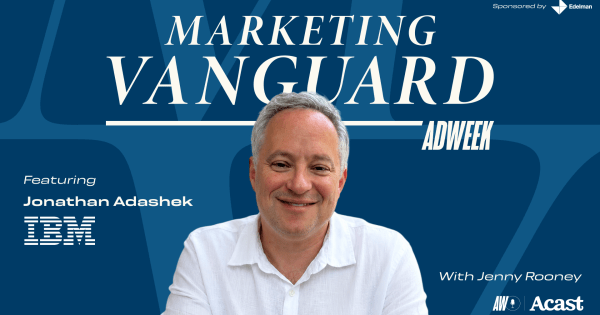
The Marketing Vanguard Cannes series continues as host Jenny Rooney sits down with Jonathan Adashek, SVP of marketing and communications at IBM, to unpack how marketers should be treating AI today.
He breaks down how AI is becoming a way to rethink processes and drive measurable growth at IBM, their “client zero” approach, $4.5 billion in savings over three years, and why the company now does half the number of events it did two years ago.
This episode is part of a special vidcast series that was recorded at Cannes Lions 2026 and presented in partnership with Edelman.
Jonathan Adashek is SVP of marketing and communications at IBM, where he leads marketing, communications, and CSR. He joined IBM in January 2020 as Chief Communications Officer and took on the marketing portfolio in January 2022.
In his role, Jonathan helps shape IBM’s global narrative as the company sharpens its focus around hybrid cloud, AI and open technology. His background in communications and politics gives him a distinct view of marketing: build a clear story, bring people on the journey and connect brand work more closely to business outcomes.
At IBM, he has helped drive AI adoption across processes, event strategy, customer segmentation and internal operations through the company’s “client zero” approach.
[06:37] Why “What Does IBM Do?” Became a Brand Wake-Up Call — When Jonathan got the IBM job offer, one of his best friends, a tech executive, asked him a blunt question: “What does IBM do?” That moment crystallized the repositioning challenge. If someone in the tech space could not answer clearly, the brand needed sharper focus. Jonathan’s takeaway was not to abandon IBM’s history, but to ground the company more clearly in what it does today so people know when and why to come to IBM.
[08:36] Why AI Adoption Needs Process Discipline — Jonathan explains that IBM has mapped processes across his organization to understand where AI can help automate, simplify or eliminate unnecessary work. But the bigger point is that AI adoption is not just about adding tools. Teams need training, time and a clear understanding of how workflows change when different people use different tools. Without that discipline, organizations risk creating thousands of agents that do not talk to each other, silo data and create runaway token costs.
[10:07] Client Zero and the AI Proof Point — IBM calls its internal AI implementation “client zero.” The work started with processes, efficiencies and better outcomes, and has helped drive $4.5 billion in savings over three years, with another billion committed this year. But Jonathan is careful to make the sharper point: this is not only about cost takeout. The real value is becoming more effective, more efficient and more growth-focused. IBM is using its own operations as the case study.
[10:28] Half the Events, More Leads — One of the clearest examples of IBM’s AI impact is event strategy. Jonathan says IBM now does half the number of events it did two years ago, but gets 10 to 20% more leads and interest from those events. The reason is better AI-enabled targeting, personalization and relevance before and after the event. It is a useful correction to the “do more” instinct in marketing. Better targeting can beat more activity.
[11:15] The…