
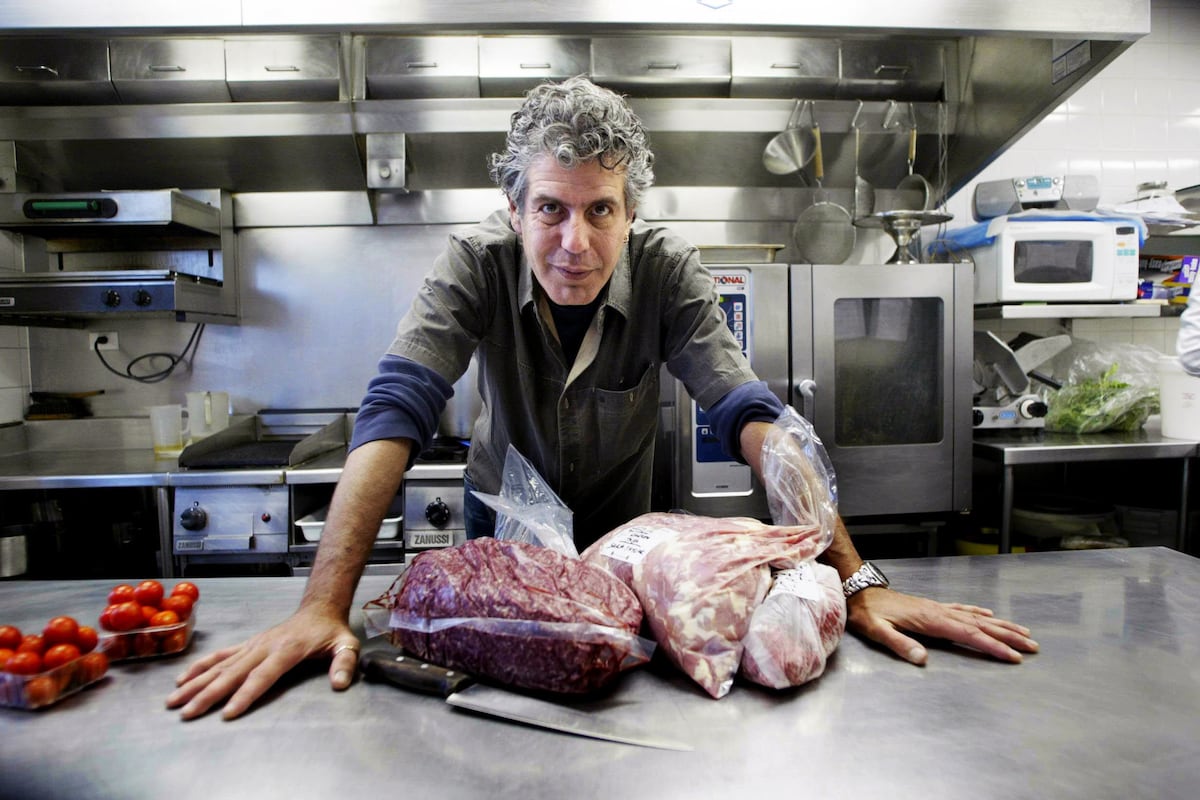
The trope of the Angry Young Man was not born in a kitchen, but Anthony Bourdain’s particular myth-making created what might be the prototype for late-20th-century masculinity. As the director of Tony, the new biopic of Bourdain focusing on his first job, has said, the film is about “a magical world where nothing can go wrong and a young man who’s angry about it”.
Bourdain arrived in that job, as a dishwasher in a restaurant in Provincetown, Massachusetts, aged 19. He was hellbent on a life of formless, self-sabotaging rebellion, and found his tribe. But when he published his book Kitchen Confidential in 2000, a quarter of a century later, he set the ethos of that kitchen tribe in stone and attracted an ever-replenishing pool of chefs who, if they weren’t already just like him, were prepared to die trying.
However, that anger, like everything about Bourdain, wasn’t real – it was performative, playful. He compared himself once to the chef Eric Ripert, saying they both had a “live-and-let-live energy”, but Ripert “believes in karma . . . I believe in vendetta”. That fabled anger never sounded quite real.
Kitchen Confidential starts with Bourdain travelling through France as a child with his brother and his moneyed American parents of European inclinations and heritage. He is an insufferable little pain towards his family, for no reason, and he’s also a git to the French kids, before returning to the US to be a jerk to flatmates and girlfriends in his private liberal arts university (Vassar) before dropping out.
He’s still in his teens in 1975 when he takes that lowly job in Provincetown. There, he’s a minnow among absolute sharks of delinquency – a chef might turn out an impromptu service for a 100-strong post-wedding party, then bang the bride against the bins afterwards. The staff scored drugs you’ve never heard of, and drugs you’d never have needed if you hadn’t taken all those other drugs.
In that kitchen, Bourdain finds his spiritual home, “a subculture whose centuries-old militaristic hierarchy and ethos of ‘rum, buggery and the lash’ make for a mix of unwavering order and nerve-shattering chaos,” he wrote in Kitchen Confidential. That book, remembers the journalist, cookery writer and cook Diana Henry, 63, described “a world we didn’t have an in on, and suddenly we did”. (Henry did, in my view, the best late-era interview with Bourdain, two years before his death.)
Bourdain described his mission as a chef: “Your body is not a temple, it’s an amusement park. Enjoy the ride.” In his writing, as in his cooking, he prioritised pace and crunch over elegance and fuss. Relationships in this brigade system were tightly bonded and savagely caustic. “As an art form, cook talk is, like haiku or kabuki, defined by established rules,” he wrote. “All comments must, out of historical necessity, concern involuntary rectal penetration, penis size, physical flaws or annoying mannerisms or defects.”
Between the drugs, the shagging, the late nights, the contradictory, hurtling imperatives of discipline and self-indulgence, the contempt for self-care and the penis jokes, this was a definitionally masculine ideal, and not even for so childish a reason as that you’d need a dick in order to dip it in someone’s Vichyssoise. There’s just no female model for being beautiful, high and still smashing it at work: the women in this space (just off the top of my head, Nancy Spungen, Amy Winehouse) end up dead.
In many ways, Bourdain was just saying what h…