
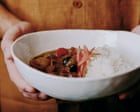
Japanese curry needs to be thick enough so that it can be easily eaten with rice, with the help of a spoon. Photograph: Emiko Davies View image in fullscreen Japanese curry needs to be thick enough so that it can be easily eaten with rice, with the help of a spoon. Photograph: Emiko Davies Australian food and drink Emiko Davies’ Japanese curry rice (kare raisu) – recipe The Australian-born cook and author shares her recipe for a thick, fragrant Japanese curry – with one secret ingredient
Prefer the Guardian on Google J apanese curry – kare raisu in Japanese – is unlike any “curry” you might know from south Asian countries. That is partly because of the nature of yoshoku (western-influenced) cuisine but also because it made a roundabout route to Japan, via the British Royal Navy during the Meiji Restoration, a period when India was under British colonial rule. It arrived in the form of British “C&B” curry powder, so it was considered western food, not Indian. Curry became a staple in the Japanese naval and army kitchens at the turn of the century and this in turn brought curry into homes and even into school lunches. Today, it is considered a national dish.
View image in fullscreen Today, kaire raisu is considered a national dish in Japan. Photograph: Emiko Davies Japanese curry needed to be thick enough so that it could be easily eaten with rice, with the help of a spoon. This can be achieved with a French-style roux base of butter, flour and liquid, or it can be thickened in a more Japanese style using a potato starchy slurry right at the end of cooking, which is my preference. Then there is the spice mix. Today, Japanese S&B curry powder is one of the best known, which contains 17 spices such as turmeric, coriander, fenugreek, cumin, cinnamon, fennel, ginger and star anise.
In Japanese homes, it is most often made with a packet mix in the form of waxy cubes that you add to a stew of meat and vegetables. The cubes dissolve, turning the stew into a thick, fragrant, mild Japanese curry. Everyone has their favourite brand, or perhaps two favourite brands mixed together, that they pump up with “secret” ingredients – honey, nashi or prunes for sweetness, or coffee for colour and balance. My mother told me of a friend who liked to add dark chocolate. I know how well that works in a meaty stew – chocolate or cocoa is a popular addition to an age-old Tuscan wild boar stew that I love.
300g pork loin (or beef, or other protein of choice) Vegetable oil , for greasing 40g butter 1 onion , sliced 4cm piece of fresh ginger , peeled and finely grated 2 tbsp mirin (or white wine) 1 tbsp curry powder 2 tsp garam masala ¼ tsp chilli powder, optional 500ml dashi (see below), chicken stock or water, 2 cups 1 tbsp soy sauce ½ tsp salt 1 carrot, peeled and chopped into chunky slices 200g potato, peeled and chopped 80g mushrooms, roughly chopped 2 tsp potato starch or cornflour 1 tbsp water , or as needed 1 cube dark chocolate , about 10g, minimum 70% cocoa solids Rice and pickles to serve – I love beni shoga (red pickled ginger) and rakkyo pickles (pickled Chinese onion)
Chop the meat into 3cm cubes. Heat a little vegetable oil in a heavy-based saucepan over a high heat and sear the meat on all sides, about four to five minutes in total. Remove the meat and set aside.
Reduce the heat to medium and add the butter to the pan, followed by the onion and ginger, and stir quickly so the onion doesn’t burn, cooking with all the browned bits gathering at the…