
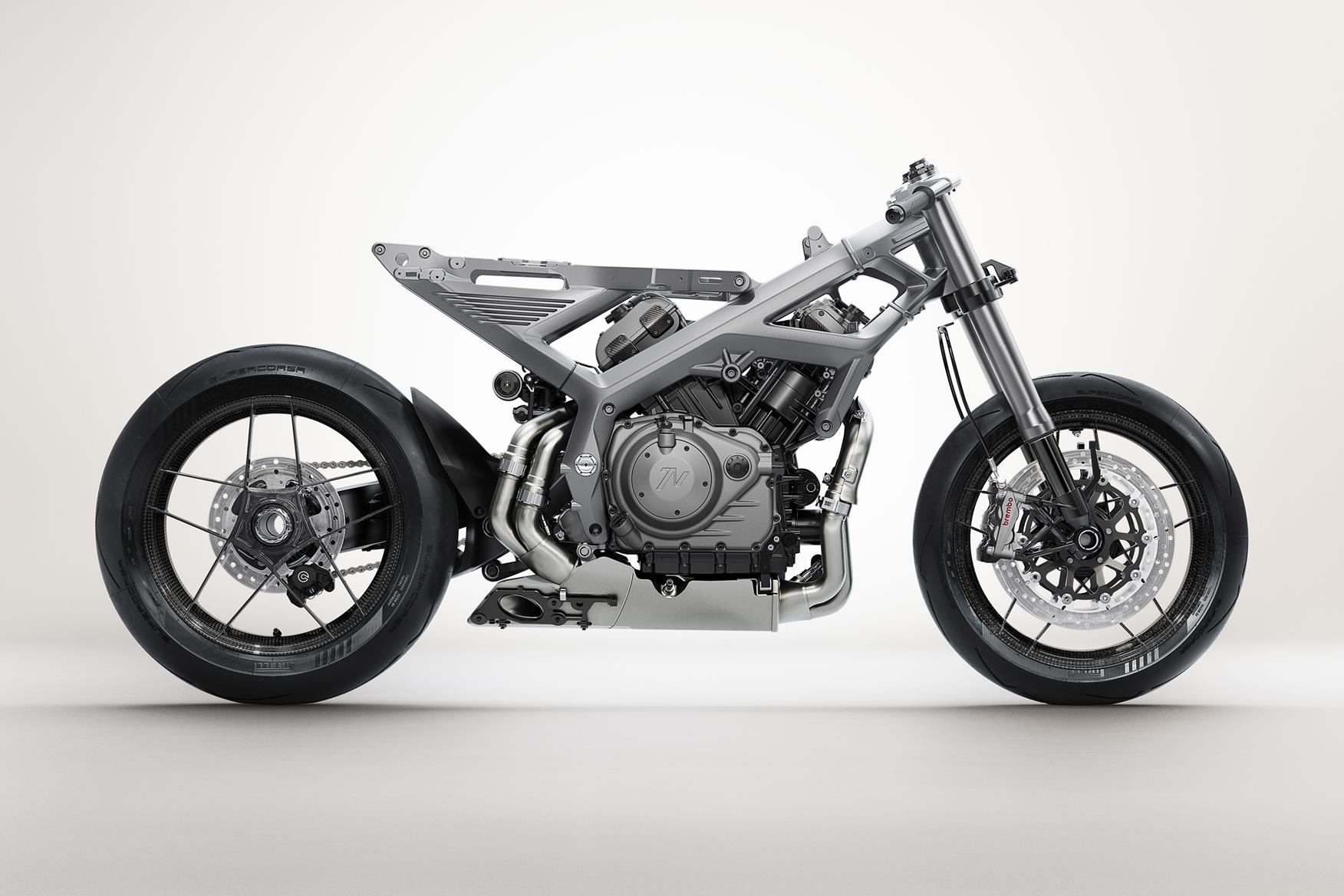
There’s a moment in every manufacturer’s comeback story where the marketing has to give way to evidence, and for Norton – a brand that has burned through more goodwill than most over the past decade – that moment matters more than it does for almost anyone else.
So it’s telling that, with the new Manx R now in the hands of the first customers, the Solihull firm have chosen to open up the R&D programme behind it, and the numbers they’ve put on the table are not small ones.
They say behind the bike is more than 500,000km (310,000 miles) of development and validation, over 20,000km (12,000 miles) of it on track; more than 100 prototypes; upwards of 700 individual tests; and feedback from over 50 riders ranging from everyday enthusiasts to Isle of Man TT champions and Italian Supersport racers.
Norton say they treated rider feel as a hard engineering target, weighted equally alongside performance, durability and software, so that a bike physically couldn’t be signed off just because it had hit its numbers. And nowhere is that thinking clearer than in the engine.
Before a single specification was decided upon, Norton fitted telematics to development and rival machines and logged 218,000km (135,000 miles) of real riding – engine speed, throttle position, gear selection, temperatures, the lot.
The data told them that more than 98% of riding time, even among quick, experienced riders, happened between idle and 7000rpm. So rather than chase a peak-power headline, they built the torque where riders will use it.
The all-new 72-degree, 1200cc V4 duly makes a claimed 206bhp at 11,500rpm and 96lb.ft at 9000rpm, with 77% of that torque on tap from 5000rpm. It’s a deliberately different approach to a Ducati Panigale V4 , which makes its 213bhp peak at 13,500rpm, or a BMW S1000RR , which finds its matching 206bhp at 13,750rpm.
“If you’re going to ask riders to believe in a new superbike from Norton, you have to put proof on the table,” said Chief Technical Officer Brian Gillen. “Real mileage, real conditions, and a level of validation that stands up to real scrutiny.
“But what defined this programme was that rider feel was treated as a hard requirement, not a nice-to-have. We didn’t just want data that said the bike was right.
“We listened hard to our test riders, who consistently described the Manx R as ‘special’. Their reactions kept coming back the same: a real grin factor, an ‘addictive’ V4 exhaust note, and a feeling of connection they described as genuinely different to anything else in the class.”
On that last point, at least, our own test bears Norton out completely. When MCN’s Carl Stevens spent two days aboard the £38,750 Signature edition, he rated it four out of five and reserved special praise for that engine’s voice, calling it “one of the finest soundtracks from a standard exhaust that you’ll find anywhere.”
The road-focused torque delivery was borne out too – it’s an engine that “does hit the spot” as a Sunday-morning companion, happiest short-shifting between 5000 and 9000rpm, never overpowering, exactly as the telematics-led brief intended.
Where Norton’s story and our road tester’s are less aligned, though, is on throttle response. The firm talks about accurate, predictable pick-up; on test we found “a slight delay on the initial twist of the grip that is almost akin to having a bit of slack in a cable”, which is not what you expect from modern ride-by-wire.
Add a clutch sharp enough to stall the bike from a standstill an…