
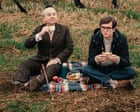
Like Sancho Panza and Don Quixote … Luis Gnecco and Fionn Whitehead in Borges and Me. Photograph: Courtesy EIFF 2026 View image in fullscreen Like Sancho Panza and Don Quixote … Luis Gnecco and Fionn Whitehead in Borges and Me. Photograph: Courtesy EIFF 2026 Film Review Borges and Me review – a sweetly imagined literary odyssey through the Highlands Edinburgh film festival Luis Gnecco brings warmth, wit and quiet melancholy to Jorge Luis Borges in this gently enchanting adaptation of Jay Parini’s semi-fictional memoir
Peter Bradshaw Sat 15 Aug 2026 22.36 CEST Last modified on Sat 15 Aug 2026 22.37 CEST Share Prefer the Guardian on Google T here is great sweetness and high-minded, unworldly charm in this adaptation of American author Jay Parini’s embellished memoir , a romantic account of his road trip through the Scottish Highlands that, as a young doctoral student at St Andrews in 1971, he really did take with Jorge Luis Borges , the great writer whose blindness had become part of his mystique. Author of poetry, enigmatic short stories and metaphysical vignettes untranslatably known as the “ficciones”, Borges is described here as “the father of magical realism” – although he is surely more unique and interesting than that.
Parini drives Borges around, describes everything to the maestro (who is rapt and beaming), and shields him when he uninhibitedly urinates in public; all the while he is almost entirely unaware of Borges’ reputation and the enormous honour that this therefore was. Fionn Whitehead plays the callow young Parini, in specs and duffle coat resembling a young Tom Courtenay, wretched that he may have inadvertently persuaded his brother Billy back home to volunteer for military service in Vietnam. He is ungratefully grumpy that he has to spend time away from his PhD for this babysitting task, assigned to him by his supervisor, poet and Borges translator Alastair Reid, played by Alan Cumming . Borges himself is entertainingly played by the Chilean actor Luis Gnecco; priestly, childlike, mischievous and sly, a performance executed with theatrical panache – I can imagine him doing it on stage – but without hammily overdoing the milky-eyed upward gaze. His Borges is a man who like all charming people has cultivated a dependency on others, and we can see how he has had a lifetime to deploy the combination of his huge reputation and the poignant helplessness of the blind. He has come to Scotland without a nurse or amanuensis and has to rely on the (cowed) kindness of strangers.
Parini and Borges are like Sancho Panza and Don Quixote, whose presence is duly hallucinated at one stage, though it is odd that Borges, that profound Scotophile, does not specifically invoke Boswell and Johnson in the Outer Hebrides . It may be that screenwriter Oren Moverman, or Parini himself, is influenced by Gore Vidal’s memories of guiding around his blind grandfather, US senator Thomas Pryor Gore, whom he described as a “passionate sightseer”. Borges himself, in this film, on being introduced to the hesitant Parini, whimsically says: “Speak up – I am blind!” Borges is a huge Bob Dylan fan – and, apropos Vietnam, anti-war – although the script does not specifically anticipate Borges’ description of the Falklands war : two bald men fighting over a comb.
The source material is avowedly fictionalised and unreliable, and this is never more obvious here than in the fanciful scene in which Borges demands to be rowed by Parini out into the middle of Loch…