
One perk of being a technology analyst is getting samples of the latest devices to evaluate. A few weeks ago, Samsung sent me its latest premium foldable smartphone, the Galaxy Z Fold8 Ultra .
After putting it through its paces for several weeks, something occurred to me: given I’ve been a staunch iPhone user for two decades, the learning curve on Android was more challenging than I cared to admit.
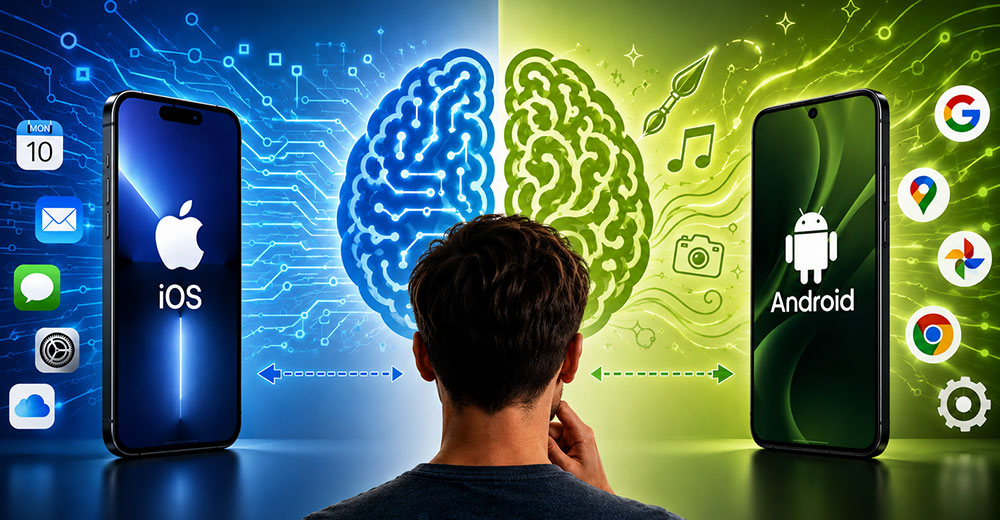
After all, when you spend enough time around longtime smartphone users, you’ll hear the same responses: “I just can’t use Android,” or “I could never switch to an iPhone.” It’s easy to assume this stems from the commonly held belief that some people are more “left-brained” — analytical and structured — while others are more “right-brained” — visual and intuitive.
Modern neuroscience doesn’t really support that theory. While the brain does have specialized functions in its two hemispheres, research has not found evidence that people can be broadly categorized as left-brain or right-brain personalities. A University of Utah brain imaging study of more than 1,000 participants found no evidence that people prefer one hemisphere over the other, as some popular psychology suggests.
There is no scientific basis for saying some brains are wired for iOS and others for Android. What is going on arguably has more to do with years of learned behavior than brain dominance.
The iPhone came out in 2007, and commercial Android phones in 2008, so millions of consumers have had close to 20 years to become accustomed to one platform.
That repetition matters because most longtime users don’t consciously think about how to return to the home screen, share a photo, switch applications, answer a notification, or change a setting. Their fingers just know what to do. This is procedural learning, where repeated behaviors become more automatic and require less conscious thought.
Research on technology adoption and switching emphasizes the significance of habits, switching costs, and inertia. Moving to another platform requires relearning familiar behaviors, making longtime users less willing to change.
This phenomenon also explains why an experienced iPhone user can pick up an Android phone and immediately find it confusing. The Android phone might perform the task perfectly well, but what the user often experiences is “It doesn’t work the way I expect it to work.”
This distinction is important because familiarity can easily be mistaken for superior usability.
iOS and Android have created their own interface languages over the last two decades. Users learn where controls are, what gestures mean, how notifications behave, and how applications talk to the operating system. Over time, those behaviors become almost invisible.
It’s like getting in a car where the accelerator and brake pedals are swapped. In theory, the new arrangement could work just as well, but your immediate reaction would be that the car is terribly designed because your existing mental model no longer applies.
That’s essentially what happens when a longtime smartphone user changes operating systems. A 15-year iPhone user will find iOS intuitive, but that's because they've been learning iOS all along. Common tasks on Android suddenly become things they have to think about.
The same goes for longtime Android users switching to iOS. This lack of familiarity leads to discussions about which operating system is "easier" and can obscure the distinction between inherent and learned usability, bec…