
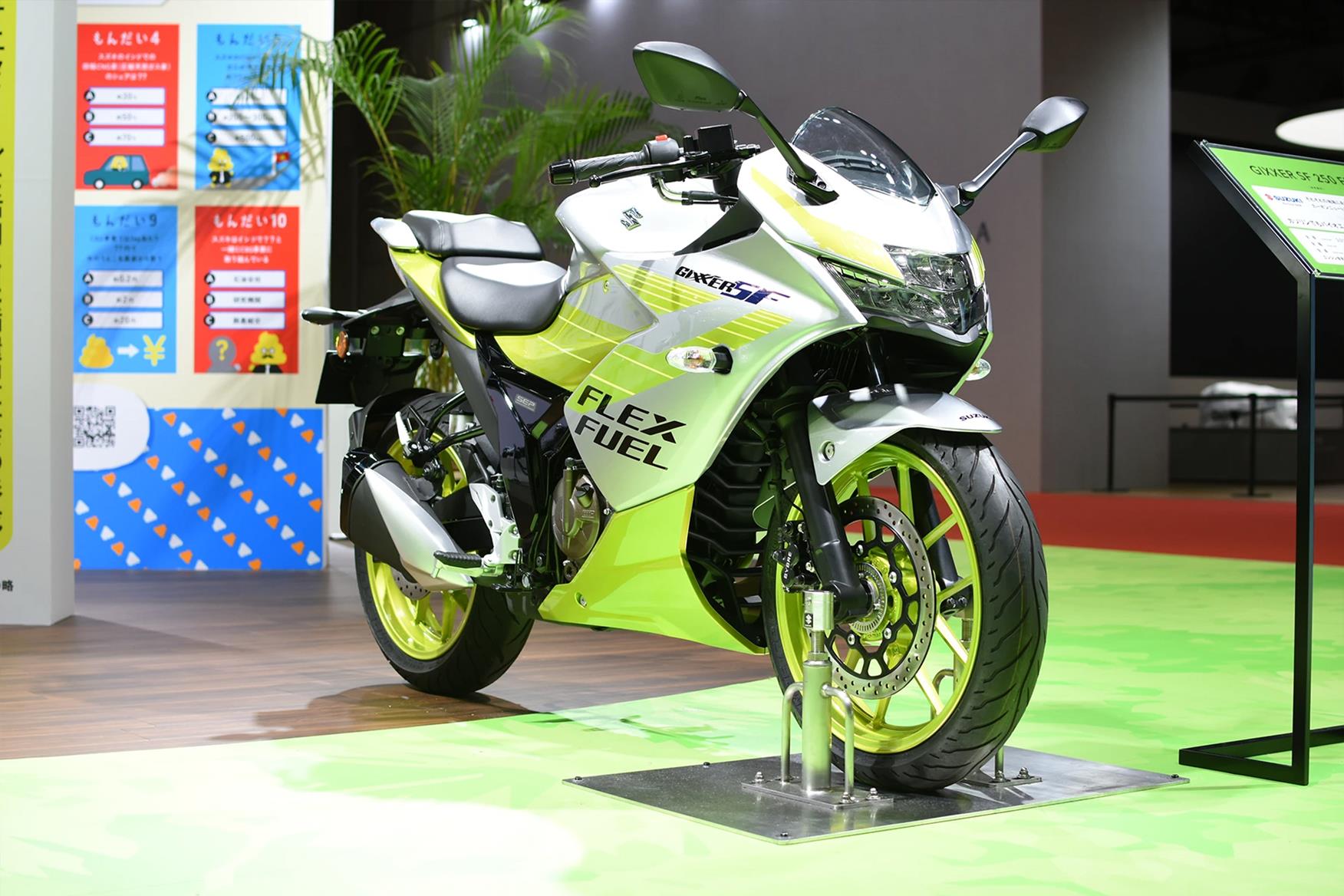
Suzuki have launched their first flex-fuel motorcycle, the Gixxer SF 250 FFV – a machine engineered to run on anything from ordinary petrol to E85, a blend containing up to 85% ethanol.
The ‘flexible-fuel vehicle’ (FFV) is aimed at the Indian market and is not expected to reach the UK, but it’s a significant statement of intent. It backs up Suzuki’s wider plan, laid out in their Technology Strategy 2025, to keep developing the internal combustion engine alongside hybrids and electric bikes, provided the fuels feeding it keep getting cleaner.
Crucially, the FFV isn’t tied to a single fuel. It can run on pure petrol, E20 (20% ethanol) or E85, and the engine automatically adapts to whatever mix is in the tank. That means riders can fill up based on cost, availability or emissions, without worrying about compatibility.
Since launching in 2025, Suzuki say demand for the FFV has been steady, if unspectacular so far – a reflection of the bike’s role in a much longer-term national strategy.
“Since its launch in 2025, it has sold consistently,” Suzuki’s Shiokawa Sho told MCN. “This model was developed with a primary focus on the Indian market, aiming to support the Indian government’s initiative to promote E85 fuel.
“As the infrastructure for E85 refuelling stations in the country is still in its early stages, our sales have remained at the above mentioned level. However, we anticipate that sales will increase as the refuelling station network continues to expand.”
Ethanol is essentially alcohol, and most of it comes from renewable plant sources such as sugarcane, corn and agricultural waste – so it’s considered greener than fuel refined purely from crude oil. Although burning ethanol still releases CO2, the crops used to make it absorb CO2 as they grow, so the net lifecycle emissions come out lower than fossil fuel.
Standard engines are only designed for low ethanol mixes, so a flex-fuel engine has to be built to cope with a far wider range – which is where Suzuki’s re-engineering comes in. To handle up to 85% ethanol, Suzuki upgraded the fuel injector’s internal materials to resist the corrosion caused by moisture in ethanol, and increased its flow rate.
The fuel pump gets an internal rust-prevention treatment and a higher flow rate too, while a dual-filter setup – a coarse filter at the pump inlet and a fine mesh filter between pump and injector – guards against contamination and clogging.
The clever part is the electronic control. The engine uses its O2 sensor to estimate how much ethanol is in the tank, then adjusts the fuelling in real time, constantly analysing combustion and adapting to the blend. It’s the same principle MCN highlighted when E10 arrived in the UK : modern bikes with O2 sensors in the exhaust automatically recalibrate the injection for the best burn.
Ethanol is harder to vaporise than petrol, so high-ethanol blends can hurt cold-start performance and combustion stability in low temperatures.
Suzuki’s answer is a Bluetooth-enabled digital dash with two warnings: a cold ambient temperature alert tells the rider when ethanol content is high in the cold – the engine runs normally as long as ethanol stays below 50% in the tank – while a petrol concentration warning prompts the rider to add petrol when levels climb too high in cold conditions.
The FFV uses a 250cc single-cylinder SOHC engine with Suzuki’s Oil Cooling System (SOCS) and Suzuki Eco Performance (SEP) technology, mated to a six-speed gearbox.
Interestin…